2036: Looking Back

Organic Fiction
by

editor's note: this is fiction but we want to present a picture of a possible future, not to trivialize real suffering.

It has been a full dozen years since I left Venezuela, a country unraveling at the seams, at the tender age of 12. I journeyed to Austin, Texas—a city I had only glimpsed in photographs—where I found not only refuge but also a vibrant community and unforeseen opportunities.

Among the most impactful of these opportunities was my introduction to ReLeaf Cooperative, a forward-thinking organization dedicated to transforming waste into vertical gardens. As a newcomer to Austin, I attended one of their workshops, a modest introduction to creating modular planters from upcycled materials. What I didn’t realize at the time was that this was more than just a workshop; it was the start of a journey that would shape my life in ways I couldn’t yet comprehend.

I remember how carefully I assembled my first planter. The resourcefulness I had brought with me from Venezuela, born out of necessity, became my compass. Each planter was a small, tangible testament to the power of transformation—just as I was transforming my life from upheaval to something steadier.

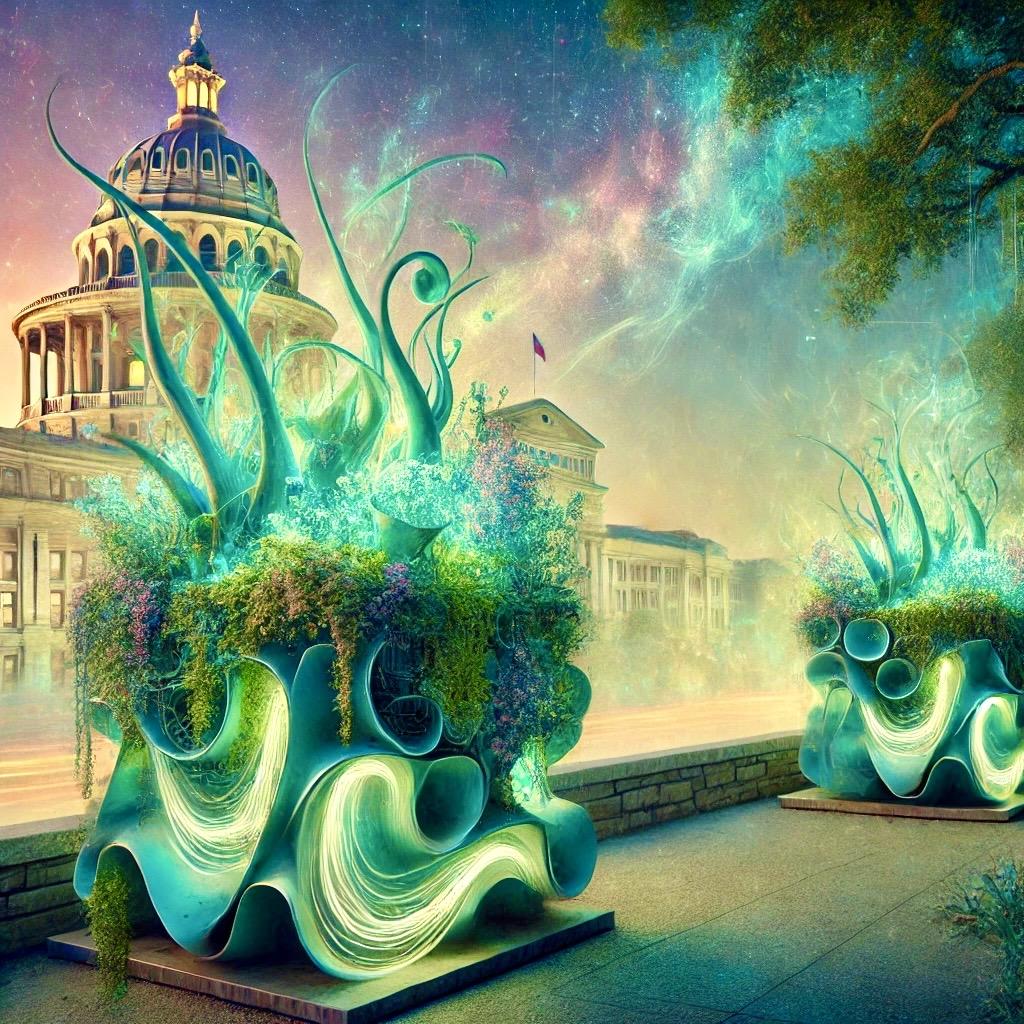
Then something unexpected happened. My planters caught the eye of a local government representative. She noticed the thoughtfulness and quality in each one, and soon enough, my creations were gracing the grounds of the State Capitol, their greenery standing tall against the Texas sky. Little did I know that this attention would set something even bigger in motion.

These planters—built from waste materials, yet thriving with life—became more than just symbols of sustainability. They began generating a steady stream of income. For the first time since my arrival, I had financial stability. But more importantly, this income allowed me to give back. Part of it went into scholarships for new immigrants, helping them learn the art of upcycling and sustainable living.

Looking back, I marvel at the journey. I had arrived in Austin as a 12-year-old boy fleeing crisis, and today, I’m part of something much larger than myself. My planters, scattered across the Capitol grounds, continue to support new arrivals just as I was once supported.

And yet, there’s a whisper of uncertainty on the horizon. Austin has transformed in these last twelve years, but so have the challenges we face. The city thrives on sustainability and innovation, but with each passing year, the stakes grow higher. As I reflect on my path, I can’t help but wonder: what will the next twelve years bring? What will become of the vibrant gardens and the lives they’ve touched?

🚮 W.A.S.T.E.: Words Assisting Sustainable Transformation & Ecology

Term Definition
Ambrosia trifida (0.00)

Ambrosia trifida, the giant ragweed, is a species of flowering plant in the family Asteraceae. It is native to North America, where it is widespread in Canada, the United States, and northern Mexico.
 

Distribution

It is present in Europe and Asia as an introduced species, and it is known as a common weed in many regions. Its common names include great ragweed, Texan great ragweed, giant ragweed, tall ragweed, blood ragweed, perennial ragweed, horseweed,buffaloweed, and kinghead.

Description

This is an annual herb usually growing up to 2 m (6 ft 7 in) tall, but known to reach over 6 m (20 ft) in rich, moist soils. The tough stems have woody bases and are branching or unbranched. Most leaves are oppositely arranged. The blades are variable in shape, sometimes palmate with five lobes, and often with toothed edges. The largest can be over 25 cm (9.8 in) long by 20 cm (7.9 in) wide. They are borne on petioles several centimeters long. They are glandular and rough in texture. The species is monoecious, with plants bearing inflorescences containing both pistillate and staminate flowers. The former are clustered at the base of the spike and the latter grow at the end. The fruit is a bur a few millimeters long tipped with several tiny spines.

As a weed

This species is well known as a noxious weed, both in its native range and in areas where it is an introduced and often invasive species. It is naturalized in some areas, and it is recorded as an adventive species in others. It grows in many types of disturbed habitat, such as roadsides, and in cultivated fields. Widespread seed dispersal occurs when its spiny burs fall off the plant and are carried to new habitat by people, animals, machinery, or flowing water. The plant is destructive to native and crop plants because it easily outcompetesthem for light.

Herbicide resistant giant ragweed populations were first identified in the late 1990s. Across much of the midwestern United States, populations resistant to group 2 (ALS-inhibitors) and group 9 (glyphosate) are present, though resistant to multiple herbicide modes of action has not yet been documented. There remains concern that herbicide resistance is more widespread than documented and many states like Minnesota offer free screening of giant ragweed for herbicide resistance. For chemical control, use of group 4 (2-4D) and group 10 (glufosinate) are effective.

As an allergen

Also, interest is great in preventing the spread of this plant because its pollen is a significant human allergen. It is one of the most familiar allergenic ragweeds, and residents of different regions begin to experience allergic symptoms as the plant spreads into the area.

Uses

Native Americans had a number of uses for the plant as traditional medicine. The Cherokeeused it as a remedy for insect stings, hives, fever, and pneumonia, and the Iroquois used it to treat diarrhea.

Giant ragweed has been used successfully as a compost activator and an ingredient in sheet mulch gardens.

Architectural Transformation (0.00)

Welcome to our exploration of Architectural Transformation, an engaging facet of urban planning that aims to revitalize and repurpose structures to meet the changing needs of our society and environment.

Architectural Transformation represents the adaptive reuse and repurposing of existing buildings and spaces to fulfill new functions or to address modern challenges. This not only conserves resources but also breathes new life into historical structures, merging the past with the future.

In this section, we dive into the world of Architectural Transformation through the lens of the ReLeaf initiative in Austin. Starting with "ReLeaf: Pioneering a SolarPunk Future Through Creative Urban Greenery," we examine how innovative approaches to urban greening are transforming city landscapes.

Our journey continues with "Sustainability's Moment: Embracing Athens' Vision in Austin's ReLeaf Initiative" and "From Windows to Wonders: Transforming Post-War Colossals with Vertical Gardens," showcasing the interplay between architectural transformation and sustainability.

We also explore the intersection of Architectural Transformation and SolarPunk fiction, illustrating how creativity and imagination can inspire real-world change in "Shadows of Harmony: A SolarPunk Tale of Unity and Choice," and "Blurring Reality and Fantasy: The Intersection of Gaming, Literature, and Income Streams."

Join us as we traverse the exciting landscapes of Architectural Transformation, discovering how the built environment around us can be reshaped to create a more sustainable, beautiful, and inclusive world.

Community Engagement (0.00)

Welcome to a world where the conventional boundaries between fiction and reality blur, where every piece of 'waste' holds the potential to transform into a component of a thriving ecosystem. This is the world of ReLeaf and Vertical Gardens.

Our content here revolves around the ReLeaf cooperative, a pioneering organization at the forefront of the sustainability and digital dignity movements. Through articles and Organic Fiction, we delve into the impact of ReLeaf's work in Austin, from challenging homelessness to revitalizing the city's green transformation.

We also explore Vertical Gardens, marvels of urban greenery that sprout from unexpected places. In schools, at homes, on the city's walls, these living structures symbolize hope and resilience. They are not only fostering creativity and community engagement but also forming the backbone of Austin's Zero Waste Initiative.

Whether you are interested in real-world sustainability solutions, or drawn to SolarPunk narratives of a hopeful future, our collection offers a unique perspective on how ReLeaf and Vertical Gardens are reshaping Austin and possibly, the world.

Floor 1 (0.00)

Welcome, intrepid explorer! You find yourself standing on the First Floor of the sprawling ReLeaf Organic Media Collections & Botanical Gardens. A sense of wonder washes over you as you realize you're surrounded by a wealth of knowledge and natural beauty.

Directly ahead, you see two grand, ornate doors. Each door leads to one of the most visited rooms within this treasure trove of a library. One door is adorned with intricate designs of rivers and creeks, signaling the entrance to the Watersheds Collection. The other door is decorated with an array of book spines, bookmarks, and paper leaves, inviting you into the Big Free Library.

In the Watersheds Collection, you can immerse yourself in writings and other media that celebrate beloved watersheds like Shoal Creek, Waller Creek, and even Marigold Town's very own Settler's Creek. It's a room where each creek, river, and tributary tells its own story, awaiting your discovery.

Alternatively, step into the Big Free Library—a haven for book lovers. This ever-growing collection is dedicated to promoting the circulation of books and other forms of organic media. Here, every shelf offers a new adventure, a new perspective, and an opportunity to engage with the world in a different way.

Now, adventurer, the choice is yours: Which room will you explore first?

Historic Homelessness (0.00)

In this next section, we invite you to envision a world where homelessness, a complex issue deeply entrenched in economic inequality, lack of affordable housing, and inadequate mental and physical health support, is no longer prevalent.

We explore how ReLeaf, an innovative company in Austin, Texas, is actively working towards making this vision a reality. Through their creative and compassionate initiatives, they are not just tackling homelessness but also shaping a future where everyone has a place to call home.

The articles that follow will explore ReLeaf's unique approach. They demonstrate how employment opportunities and community engagement, stemming from their ecological solutions of vertical gardens, are offering a pathway out of homelessness. But they do more than that. They offer a window into a future where a secure home is a universal reality.

Imagine a world where the uncertainty of shelter is no longer a concern. How would that transform our cities, our communities, our interactions? What happens when every person has a place they can call their own? A place where they can grow, dream, and contribute to society.

We begin to see that it's not just about the elimination of homelessness; it's about the creation of a society characterized by security, stability, and dignity for all. A society where everyone has a meaningful role and the opportunity to live a fulfilling life.

Join us as we journey through this potential future, drawing inspiration from the steps taken by ReLeaf. As we move through this exploration, we encourage you to imagine the transformative power of a society that has effectively addressed and eradicated homelessness.

Historic Hunger (0.00)

In this section, we explore a future where hunger is not just addressed but completely eradicated. By considering innovative solutions like those pioneered by ReLeaf, we can see how these initiatives are transforming not only our cities but the very structure of our societies.

Hunger, a challenge that has existed since the beginning of human history, is being tackled directly by ReLeaf in Austin, Texas. Their revolutionary vertical gardens are more than symbols of urban revitalization—they offer a glimpse of a future where nutritious, locally-grown food is available to everyone.

Through a series of thoughtful articles, we examine how ReLeaf's work is laying the foundation for a world free of hunger. The potential impact goes beyond food; it suggests a profound social transformation where the basic human need for nourishment is universally met.

Imagine what a society without hunger could look like. How would our interactions change if the fear and uncertainty of securing the next meal disappeared? Could this foster greater empathy, kindness, and community spirit?

ReLeaf’s initiatives give us a glimpse of this possible future. Their work shows that the answers to long-standing issues like hunger are within our reach, inspiring us to envision a world where human dignity and mutual respect become the standard. Join us as we explore this hopeful vision of a future free from hunger.

Immigration (0.00)

Immigration is a topic that often triggers passionate debates and stands at the intersection of economic, social, and cultural issues. However, within these complex debates, stories of innovation and integration often emerge, highlighting how communities and companies can play pivotal roles in shaping the immigration narrative.

In this section, we turn our attention to Austin, Texas, and the remarkable efforts of a local enterprise, ReLeaf. Through their vertical gardens initiative, ReLeaf has addressed the challenges and embraced the opportunities of immigration in a unique and inspiring way.

We delve into how ReLeaf is providing sustainable employment and community engagement opportunities for immigrants. We explore the company's role in assisting individuals in their journeys from homelessness to empowerment, and how it leverages this process to create positive change on a wider scale.

Join us as we uncover the transformative power of community-driven action in addressing immigration. As we venture into this narrative, we invite you to consider the potential of similar initiatives to inspire positive change and foster integration in communities around the globe.

Literary Criticism (0.00)

This selection of articles offers a deep dive into Organic Media narratives and eco-futuristic themes, intersecting literature, architecture, and speculative design. Through these works, we explore how storytelling becomes a vehicle for envisioning green futures and resilient societies. The articles are grounded in a mix of fiction and theory, drawing from notable works like The Crying of Lot 49 and Gödel, Escher, Bach, alongside practical ReLeaf initiatives such as urban gardening and waste management.

These discussions weave together the environmental challenges we face today with imaginative, forward-thinking solutions. From vertical gardening in urban settings to speculative parables of technology’s role in shaping ecological harmony, the pieces not only critique but offer actionable insights inspired by literature, philosophy, and cutting-edge sustainability movements.

Each article is a testament to how art and fiction can fuel change, showing how imagination blends with real-world solutions to create a future that is both possible and desirable. The symphony of eco-conscious architecture and literature, particularly in the Chthulucene, shines a light on the pathways to regenerative cities, where design and storytelling converge to guide a sustainable tomorrow.

Live Action Role Playing (LARP) (0.00)

Welcome to our exploration of LARP, or Live Action Role-Playing, an immersive form of storytelling that blurs the lines between fiction and reality.

LARP is an interactive role-playing game in which players physically act out their characters' actions. Participants not only step into the shoes of their characters but they also navigate real-world environments that have been transformed into dynamic and immersive game settings.

In this section, we delve into the intersection of LARP and innovative initiatives such as the ReLeaf project. Our first article, "Blurring the Boundaries: A Look at The Institute and the ReLeaf Initiative," takes a deep dive into the ways in which LARP methodologies are being leveraged in real-world initiatives like ReLeaf.

In subsequent pieces, "Blurring Reality and Fantasy: The Intersection of Gaming, Literature, and Income Streams," and "Imagination and Growth: How ReLeaf is Blending Fiction and Reality," we continue to explore the dynamic relationship between LARP, literature, and innovative environmental initiatives. These articles highlight the unique ways in which storytelling and role-playing can drive imagination and engagement, ultimately inspiring real-world action and change.

We invite you to join us on this journey into the world of LARP, exploring its potential for creating impactful narratives and catalyzing positive transformations in our society.

Neon Spores (0.00)

Fictional festival or real infection, a cultural bloom that disperses memory like pollen, seeding futures that never officially happened.

Organic Media and Fiction (0.00)

The rapid pace of urbanization and its environmental impact has inspired various speculative genres in literature and media. Organic Media and Fiction, a recent addition, offers a refreshing counter-narrative to dystopian futures, focusing on optimistic, sustainable societies powered by renewable energies. ReLeaf, an Organic Media and Fiction-inspired platform, epitomizes this genre by blending reality with narratives that envision a world where humans coexist harmoniously with nature and technology.

ReLeaf's ethos is rooted in the belief that a hopeful future of sustainable living is not just an ideal but a reality. It combines engaging storytelling, visual arts, and direct action to showcase the possibilities of an Organic Media and Fiction future. By merging immersive narratives with tangible solutions, ReLeaf serves as both a creative outlet and a catalyst for change.

The narratives in ReLeaf are set in cities that integrate renewable energy and green technology into their architecture, infrastructure, and daily life. From urban gardens atop skyscrapers to solar-powered public transport, these stories offer a glimpse of future urban landscapes grounded in existing technologies and practices. They provide an encouraging perspective on how our cities could evolve by amplifying sustainable practices we are already exploring.

ReLeaf's stories feature diverse, inclusive, and community-oriented societies, emphasizing social justice, community empowerment, and equitable resource distribution. These narratives reflect societal structures that could foster a balanced coexistence, highlighting the importance of these values in creating a sustainable future.

Beyond storytelling, ReLeaf engages in direct action, promoting real-world initiatives that echo Organic Media and Fiction principles. By supporting community-led renewable energy projects and sustainable urban farming, ReLeaf bridges the gap between the Organic Media and Fiction vision and our present reality, making the dream of a sustainable future feel achievable.

ReLeaf broadens the understanding of the Organic Media and Fiction genre by presenting a balanced blend of reality and narrative. It underscores that Organic Media and Fiction is not just a literary genre or aesthetic movement, but a lens through which we can view and shape our future.

The Organic Media and Fiction vision put forth by ReLeaf invites us to imagine, innovate, and create a future where sustainability is the norm. By intertwining fiction with reality, it presents Organic Media and Fiction as a plausible future, offering a hopeful counterpoint to narratives of environmental doom. ReLeaf helps us believe in—and strive for—a future where humans live in harmony with nature and technology.

Planterns (0.00)

Planterns are whimsical upcycled creations—paper lanterns transformed into one-of-a-kind planters. No two are ever the same: each Plantern carries its own identity, tied to a unique ID that connects it to specific digital media such as Organic Fiction narratives, recorded music, and other creative works.

The soft glow and airy shape of its former life remain, now reimagined as a home for trailing vines, succulents, and blooms. Made from reclaimed materials, Planterns celebrate renewal—giving discarded objects a second chance and your plants a distinctive stage to grow.

Part art piece, part living sculpture, a Plantern is both physical and digital—a tangible vessel for life linked to a story, a song, or a world you can step into.

Scalable Sustainability (0.00)

The practice of designing ecological systems, technologies, and social models that not only sustain themselves but also grow stronger and more impactful as they expand.

Shoal Creek (0.00)

Shoal Creek is changing. At the Seaholm Intake, the water and stone hold a new role for the city. Engineers and naturalists are close to confirming a time-bending effect in the current. Short pulses move both downstream and upstream. Standing near the intake leaves people rested and clear, as if a long afternoon just ended.

This site becomes a public time commons. The cooled chambers host sensors and quiet rooms. The walkway links to Central across the water. The mycelium network listens, then routes what the creek gives: steadier attention, better recall, and a calm pace for work and care.

What to expect:

Check-in stones that log a short visit and return a focus interval

Benches that sync with the flow and guide five-minute rest cycles

A simple light on the rail that signals when the current flips

A small desk for field notes and shared observations

Open data on pulse times so neighbors can plan repairs, study, and gatherings

Invitation

Come without hurry. Sit by the intake. Let the water set your pace. Then carry that steadiness back into the city.

Smoke Drift (0.00)

The restless tendency of a soul to move like vapor, searching for the fire it once came from.

Sustainable Business (0.00)

Welcome to our section dedicated to Sustainable Business, a realm that unites profit and planet, blurring the boundaries between commercial success and environmental stewardship.

In the spotlight is ReLeaf, an innovative organization that is trailblazing a new path for sustainable business practices in Austin, Texas. Our selection of articles and SolarPunk fiction explore how ReLeaf addresses various sustainability challenges, from fashion waste to climate resilience.

In a world grappling with resource depletion and climate change, we delve into how ReLeaf's cooperative ownership model not only empowers vegan values but also presents a viable, sustainable alternative to conventional business structures. We will explore how ReLeaf embodies resilience against environmental challenges, such as El Niño, while remaining a commercially viable venture.

The articles also take a critical look at the shortcomings of traditional business models and how ReLeaf stands as a democratic counterpoint to corporate corruption.

Join us as we delve into these inspiring narratives that reveal how businesses can effectively balance profit-making with environmental preservation, and in the process, spark a transformation towards a more sustainable and equitable world.
 

Upcycling (0.00)
@releaf.bryce

Upcycling

♬ original sound - ReLeaf 🍃 Bryce
Vertical Garden (0.00)

Dive into our Vertical Garden section where creativity meets sustainability. This is a celebration of the innovative approach of integrating plants into urban environments in a vertical format, a testament to human resourcefulness in the face of limited space.

Here, you'll discover a vast array of ideas on how to transform would-be waste materials into sustainable, beautiful, and thriving gardens. From DIY guides on upcycling aluminum cans into modular planters, to detailed articles and SolarPunk fiction exploring the transformative power of these gardens in various settings like Austin's schools and cityscape, the Vertical Garden category provides a deep dive into a green future.

Through the articles and stories in this section, we share and explore concepts, techniques, and innovations that align with a sustainable, circular economy, which views waste as an asset rather than a problem. Whether you are looking to start your own vertical garden project or just enjoy immersing yourself in hopeful visions of a green urban future, you're in the right place.

Join us as we explore and reimagine our relationship with nature and urban space, one vertical garden at a time.

Waste Integration (0.00)

In a world grappling with waste management crises, Waste Integration offers a novel solution. This philosophy looks beyond mere recycling or upcycling; instead, it weaves waste into the very fabric of our everyday lives in a meaningful and beautiful manner.

Explore a wealth of creative methods to turn your home and community into sustainable ecosystems, where every item has a purpose, and nothing goes to waste. From transforming scrap metal into functional art, to building modular planters out of discarded plastic, Waste Integration is a testament to human creativity and resilience in the face of environmental challenges.

With a combination of theoretical discussions, practical guides, and inspiring stories, our Waste Integration content shines a spotlight on this game-changing movement, demonstrating how each one of us can contribute to a more sustainable and circular economy.

Ledger balance

Balance
$0.00

Link to this Organic Media:
QR code for https://releaf.site/organic-fiction/2036.looking.back