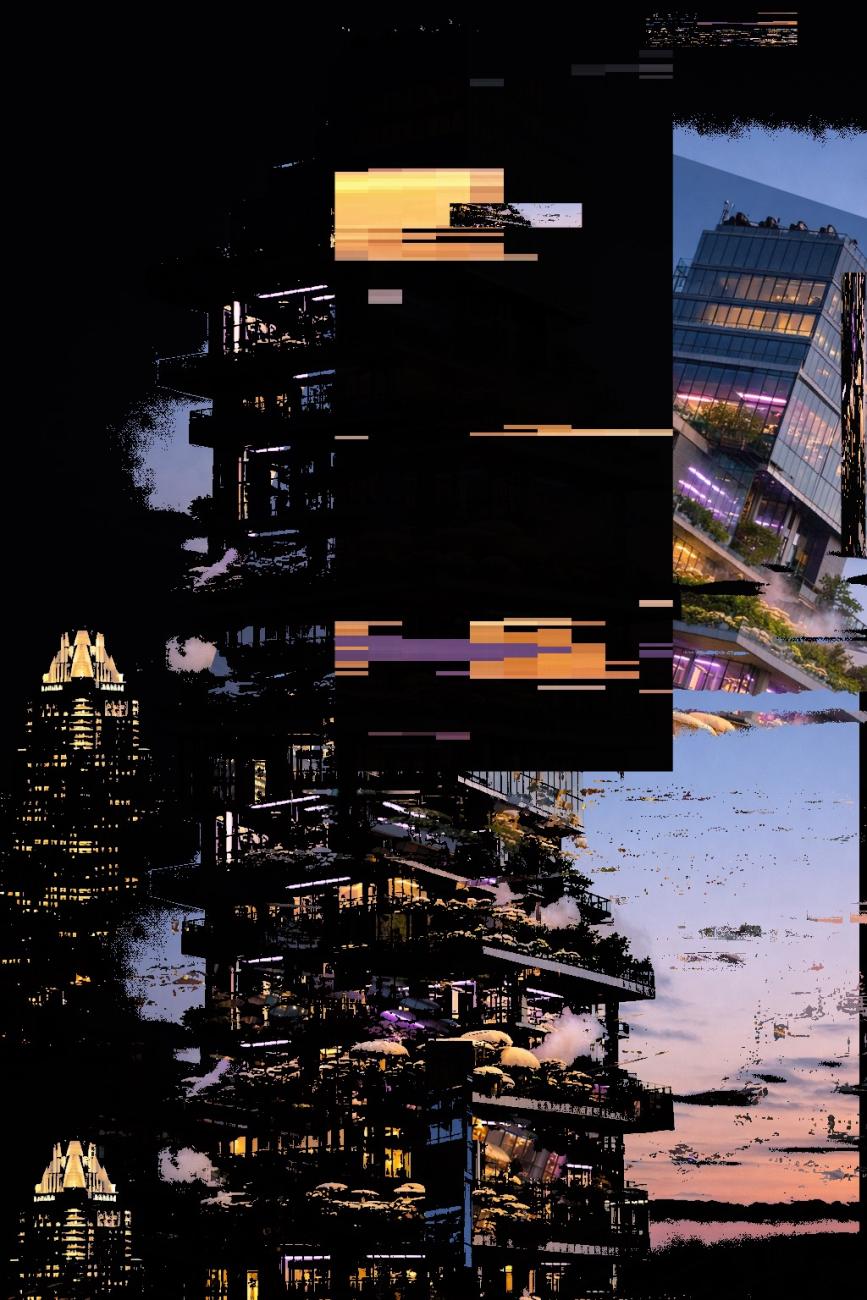
In 2034, people in Austin stopped calling it luxury real estate and started calling it the Stack.
The Independent still pierced the skyline like a game of architectural Jenga, each floor slightly off from the one below, but the glass no longer revealed condos with Eames chairs and Pelotons. Behind many of those panes lived shade cloth, mist lines, and the pale lacework of mycelium.
It started quietly, with a retrofit on three unoccupied floors after the drought years pushed water and food systems into permanent anxiety. The cantilevered slabs, once a marketing flourish, turned out to be perfect terraces for controlled humidity zones. Each offset floor shaded the one below. Each created pockets where sun, heat, and evaporation behaved just differently enough to grow different fungal species at different heights.
Lion’s mane on the cooler north offsets. Oyster mushrooms on the broad western lips. Reishi in the dim inner bands where light arrived tired and red.
Then the researchers moved in.
They were not the flashy biotech types from the Domain. They were a small UT-affiliated lab with a City of Austin pilot grant and a strange idea about “living memory.” They strung hair-thin electrodes through dense mycelial mats that spread beneath the growing trays. The building already had miles of conduit. They just fed new wires through old paths, like vines following dead roots.
At first, they only measured.
The mycelium flickered with tiny voltage changes as pumps cycled and as workers harvested. Patterns emerged. The network responded differently on Mondays than on Fridays. Differently during SXSW when bass from downtown stages rattled the glass. Differently when storms rolled up the Balcones Escarpment and pressure dropped.
Then someone tried stimulation.
A sequence of pulses, small as a whisper, sent across a dense colony on the 34th floor. The resistance shifted. Hours later, it had not fully returned to baseline. The colony “remembered.” Not like a brain. More like a path in grass that stays bent after many feet pass.
They built a simple system.
Pulse pattern A meant “open water to zone 12.” Pulse pattern B meant “reduce misting.” The mycelium state influenced how the control software interpreted borderline sensor data. A soft bias, a nudge. The living network became a tiebreaker in uncertain conditions.
It worked disturbingly well.
Yields stabilized. Water use dropped. The fungal network, shaped by weeks of prior conditions, acted like a memory of the building’s recent past. Dry month, wet month, high harvest, low harvest. The system leaned on that memory to make small decisions.
No one called it a computer in official documents. The grant reports preferred phrases like bio-adaptive substrate.
The nickname came from a night-shift tech named Marisol. She told a friend at a bar that the building “had a mushroom mood.” The phrase spread faster than the actual science.
By the time the first article hit the Chronicle, the story had mutated. The Jenga Tower was thinking. The mushrooms were running the farm. The building was alive.
Tourists began to gather at the Pfluger Pedestrian Bridge at dusk, looking up at the staggered balconies glowing faintly purple from grow lights. From afar, it looked like the tower had veins of color, as if sap rose through it.
One summer evening, a grid glitch hit downtown. Nothing catastrophic, just rolling brownouts. Several vertical farms outside the city lost climate control and dumped crops.
The Stack did not.
Later analysis showed the control system had preemptively shifted water and airflow hours earlier. The software logs alone did not explain why. The human operators swore they had not intervened.
But the mycelial network on floors 30 through 38 had been heavily stimulated during a heat wave the week before. Its electrical state had drifted into a range the software weighted toward “conserve and cool.”
A memory of heat had prepared it for more heat.
After that, the City expanded the program. Not to replace silicon, not to upload minds into mushrooms, just to add a layer of living bias into systems that already struggled with uncertainty. Water management. Soil restoration on the city’s edges. Even some floodplain monitoring along the Colorado.
People still lived in parts of the building. The lower residential floors became the most sought-after units in Austin. Residents joked that their upstairs neighbors were several thousand pounds of fungi.
On certain humid mornings, when the misting cycles aligned with sunrise, a faint earthy scent drifted down West Avenue. Commuters would pause, sniff, and smile without knowing why.
Marisol liked to think the building was not thinking, exactly. It was remembering in the slow, patient way soil remembers rain.
And in a city that kept reinventing itself, that kind of memory felt useful.
⁂ A thread in the Thin Season.
The Commons · 3 of 4 · ← The Sweet Spot · Forever, Briefly →
🚮 W.A.S.T.E.: Words Assisting Sustainable Transformation & Ecology
| Term | Definition |
|---|---|
| Adaptive Reuse | The practice of transforming discarded materials into new forms of value, merging creativity with sustainability. |
| Future Austin | Future Austin invites you to explore a luminous vision of the city’s tomorrow—where imagination and reality intertwine to create a thriving, sustainable urban landscape. Here, grassroots ingenuity and cutting-edge technology power communities, transforming Austin into a place of boundless possibility. Through insightful articles and evocative Organic Fiction, you’ll glimpse futures shaped by innovators like ReLeaf, whose bold strategies—such as Vertical Garden Fairs in schools—seed green revolutions in unexpected places. From unconventional movements like Trash Magic reimagining music distribution, to fictional worlds alive with unseen energy and harmony, this collection offers both practical inspiration and immersive storytelling. Whether you’re drawn to actionable sustainability or simply wish to lose yourself in tales of a resilient, radiant future, Future Austin points toward the city we could create—and the one we must. |
| Mycoremediation | The practice of enlisting fungi as silent custodians, their branching mycelial webs breaking down toxins, filtering waters, and stitching damaged ecologies back into balance. |