Callum Morales got out of Gatesville in the spring of 2031 with sixty dollars, a bus ticket, and a cardboard hypercube that a man named Ellis had taught him to fold in the prison library, three years into a seven-year bid.
Ellis had read Geometron to him out loud, one page a night, because Cali couldn't read well then and was ashamed of it. The book had pictures. It had shapes you could cut out of anything. It said, more or less, that a person could build what they needed from what everyone else threw away. Cali, who had been thrown away himself more than once, thought about that sentence for three years.
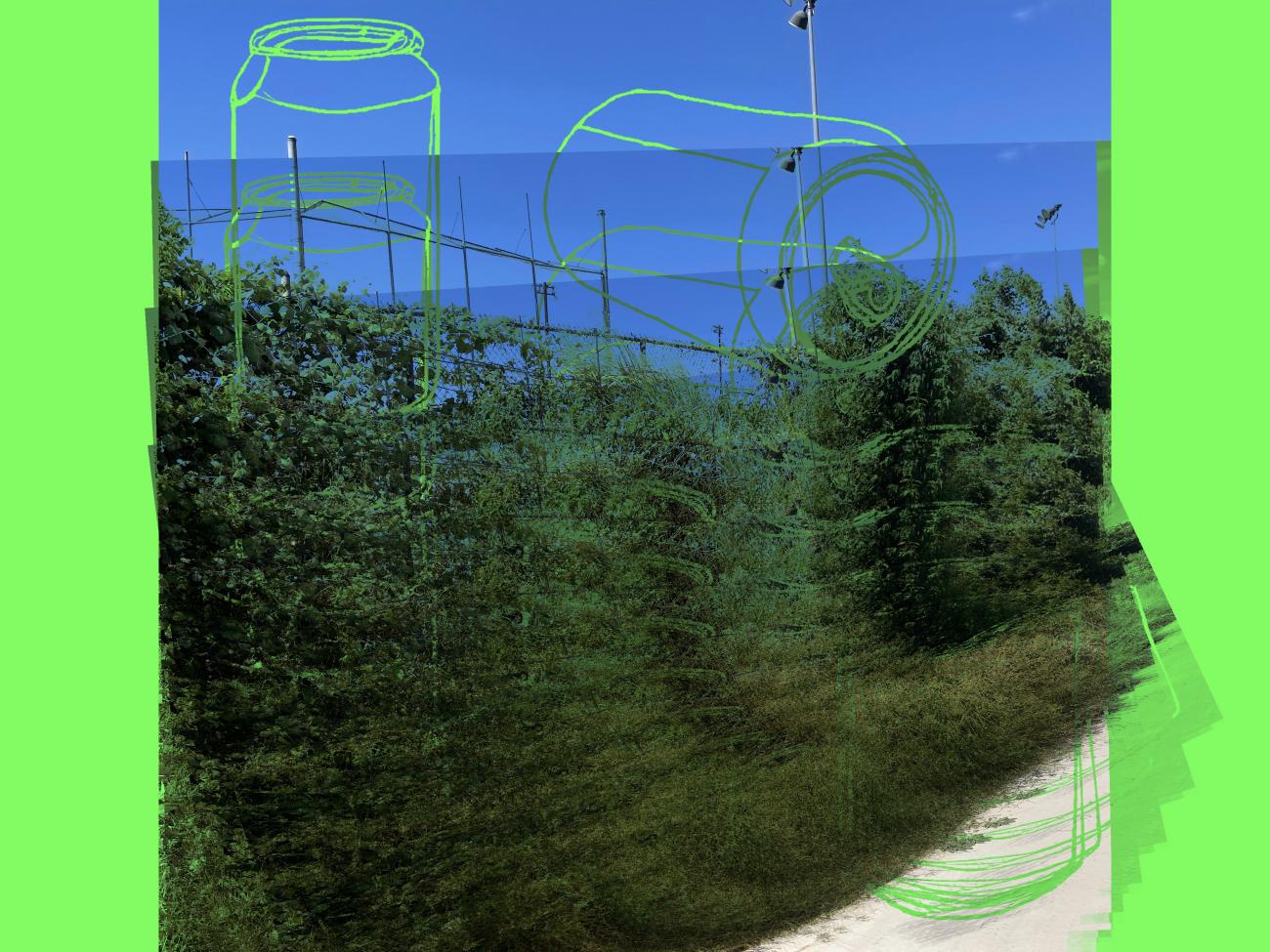
In Austin he slept on his sister's sofa in Rundberg and started folding cubes from the boxes behind the grocery store. He filled them with dirt from the vacant lot and planted beans in them, because beans were what he had. He stacked them against the chain-link fence of the lot. People walking by asked what he was doing. He said he didn't know yet.
By the second summer the fence was a wall of green, and kids were bringing him cereal boxes. By the third he was running a Saturday workshop out of a church parking lot that people called Magic Day, though he never did. Forty, sixty, a hundred people folding cardboard under the live oaks with the radio on, and someone always bringing a cooler of agua fresca, and nobody asking him where he'd been.
He liked the work for what it was. He liked it more for what it wasn't. It wasn't anything he had to explain.
As dusk descended, Cali would look out from his balcony over the cityscape he'd helped create.
That was how the reporter put it, when the paper did a story about him, and he hated it, and kept the clipping anyway. It wasn't his cityscape. It was the city's. But there was something true in it all the same. In the evenings he did stand on the little balcony of the apartment he had finally rented, with a glass of water, looking out over the lit cubes on the school walls and the bus shelters and the fence where it started. And on clear nights he could see, far off over Rundberg, a single cube in a window, cardboard and lamplit, folded the way Ellis used to fold them, with the corners tied backward.
He had never told anyone that trick. He watched that window every night for a month before he went to knock on the door.
🚮 W.A.S.T.E.: Words Assisting Sustainable Transformation & Ecology
| Term | Definition |
|---|---|
| Anemone | A writer at Vintage. She touched a railing without noticing, and the iron warmed. She tends to hear the question under a story before the story is finished. |
| Bloom Pulse | The slow beat through a QR lantern when a donation clears and a leaf lights up on the wall. Some people say it changes their breathing. Stand beside one for a donation and notice your own. |
| Copy That | A seed scattered rather than stored. Copying with acknowledgment is a gift economy: you credit the original, then you copy it, and the method outgrows its makers on purpose. Also called Scalable Sustainability. |
| Creekside Testament | A postcard tucked into a paperback about trains and distance, in a Little Free Library on the way to Clarksville. On the back, in faint writing: The creek remembers. |
| Dawn | The boardwalk at first light. A woman has already ridden the lake once, and three older versions of her are waiting there to tell her she did well. |
| Ebb and Flow | Flood the tray, let it drain, do it again: a planter’s tide. In The Verdant Veil a message is hidden in how the nutrients rise and fall, and Lex reads it off the interface. |
| Eva Marquette | A ReLeaf scientist who turned rebel when she saw what the Gardener was doing to the ecosystems. In Tangled Frequencies she steps out of an oak’s bark on her own, changed, still herself enough. Her voice rattles Langley’s chest. |
| Future Austin | Austin, a few decades on: the same creek, the same bridge at dusk, a few more vines than the zoning allows. Everything here happens to people who are trying, and are not always right. |
| Geometron | A way of describing the world as shapes you can draw with a compass and a straightedge, and build from what other people throw away. Also a book of the same name by Trash Robot, passed hand to hand in the city until its cover went soft as cloth. Mina found one on the returns cart at Central and read it standing up. |
| Prison Abolition | In the prison library Ellis folded a cardboard hypercube and read Geometron aloud, one page a night, to a man ashamed that he could not read well. Callum got out in 2031 with sixty dollars, a bus ticket, and the cube. |
| ReLeaf | The cooperative that keeps the gardens, the stories and the van. Nora Sanchez started it, and whoever tends it owns a share. The name is a leaf turned over. |
| RootFounders | The first cohort of ReLeaf, scattered now. In the rehearsal years, when the first gardens were being tuned on rooftops and bus stops, they staged concerts with soda tabs for cymbals and mulch for reverb. |
| Rootpulse | A faint vibration sensed through soil or concrete when bio-infrastructure awakens. |
| Skeletron | Sticks, cord, tension. Drill a hole in the end of each stick, tie the corners with square knots, and the shapes stand up by themselves. The original instructions say to build it up and down every river valley on the planet, and creeks. |
| Stillness Burn | The glow that stays after you have touched the nothing, and cannot be summoned by effort. Meditation does not bring it back, nor qigong, nor heated yoga. It does not come when called. |
| Trash Magic | A person can build what they need from what everyone else throws away. Callum learned it in a prison library and teaches it on Saturdays under the live oaks, with the radio on and a cooler of agua fresca. He never called it Magic Day. |
| Trash Magic Server | A server installed on a laptop that someone threw away. It holds the book of Geometron and the scrolls, and it copies itself onto the next laptop. The instructions are public. |
| Trash Transmutation Tower | Two vertical gardens at Congress Avenue and Cesar Chavez Street, with a compass rose engraved in the walkway between them, one node on the W.A.S.T.E. network. Whatever goes in as waste is meant to come out as green building material. |
| Upcycling | Making a thing better than it was by making it into something else. In the city it stopped being a word anyone said aloud; it became the ordinary way of doing things. A sparkling-water can now holds creek gravel, a succulent, and some fossils that did not comment. |
| Vertical Garden | A garden that grows up instead of out: cans, wicks, a strip of cloth for water. It is the plain thing ReLeaf does, and the thing most of the stories hang on. Mrs. Delgado’s is the one the neighbors ask about. |
| W.A.S.T.E. | Words Assisting Sustainable Transformation & Ecology. Also the underground post in Pynchon’s The Crying of Lot 49, with its muted horn on the box and its letters that travel outside the official mail. Put a word in. It will get where it is going. |
| WasteSpeech | The city’s grammar. Every alley has its own syntax: bottles grown into trellises, chip bags pressed into shade. Its rhythm is measured in reuse, and it falters when a silver cube turns up with nothing to say. |