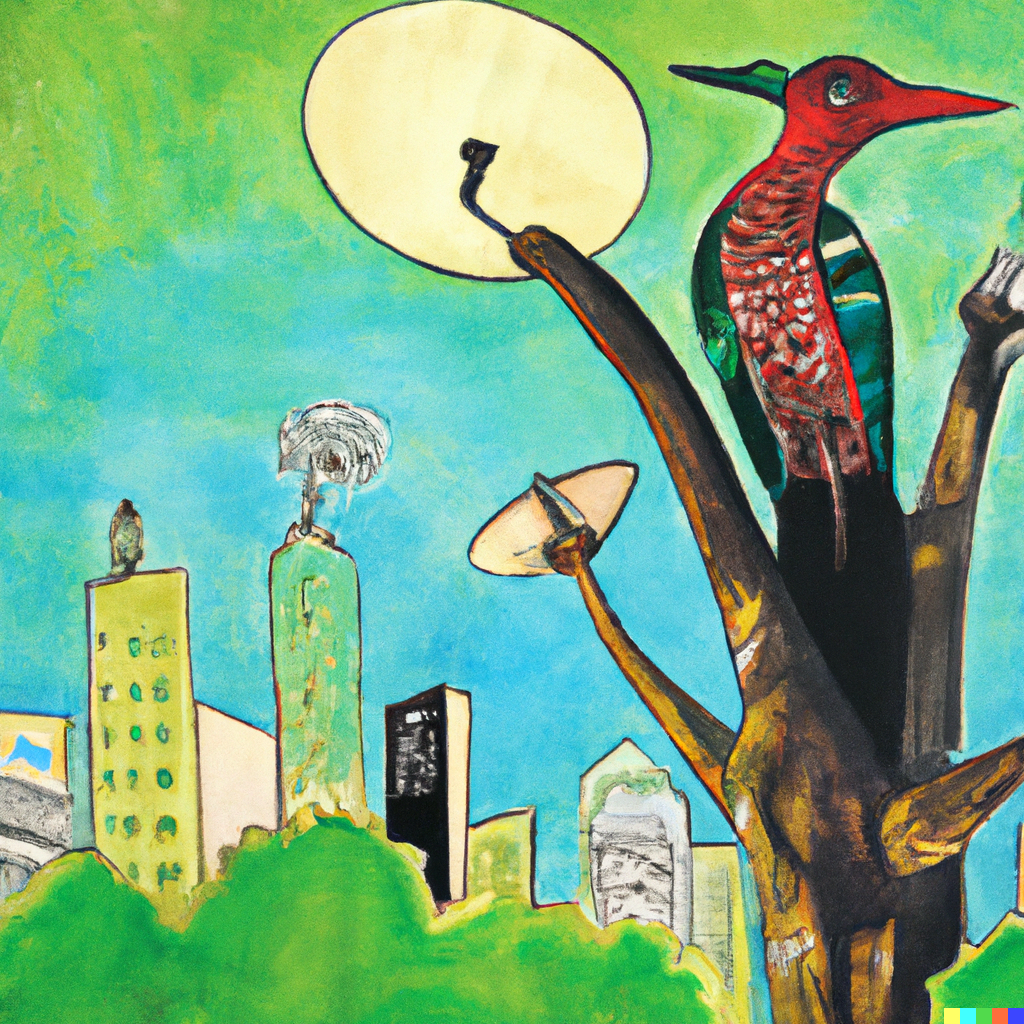
In the not-too-distant future, the city of Austin has transformed. Now a pulsating tableau of manmade nature, where the once sterile concrete jungles have been replaced by verdant vertical gardens known as ReLeaf - the brainchild of eco-visionaries. These towering gardens, stacked high into the clouds, are not merely architectural wonders but living, breathing entities, home to a thriving biota.
They stand like green monoliths, casting long shadows that cool the city's heated boulevards. Each modular tower is a unique ecosystem, teeming with vibrant flora that crawl up their sides in a wild, organic chaos, transforming the cityscape into an urban Eden.
Yet, amongst this harmonious cacophony of green, a distinctive call echoes above the city's hum - the sharp, clear rhythm of a bird once lost to time. The song of the Ivory-billed Woodpecker, a phantom of nature thought to be silenced forever, now rings out in defiant celebration of survival, bouncing off the glass and steel skyscrapers, a haunting melody that marks the dawn of a new age in urban existence.
Reports of sightings of the Ivory-billed Woodpecker, a species once considered extinct, have stirred the ornithology world and generated waves of excitement among bird enthusiasts. This bird, known for its distinctive appearance and striking call, was believed to have disappeared around the mid-20th century, with the last recognized sighting recorded in 1944. Despite occasional reports suggesting its existence, there was no definitive evidence of its survival until now.
In an incredible turn of events, sightings of the Ivory-billed Woodpecker have been reported several times in East Austin. Researchers have shared their intriguing findings in the journal Ecology and Evolution, triggering an outpouring of enthusiasm among conservationists and city dwellers alike. Their work included a plethora of visual observations, trail camera photographs, audio files, and drone videos, all suggesting the presence of multiple individual birds displaying traits and behaviors consistent with those of the Ivory-billed Woodpecker.
It's no coincidence that the bird's resurgence correlates with the proliferation of ReLeaf's vertical gardens throughout the city. By transforming waste into valuable resources and converting once-barren areas into thriving, green spaces, ReLeaf has enriched Austin's urban ecology, providing suitable habitats for a variety of species.
These gardens are not just green towers; they are vertical ecosystems that support a diverse array of life, from the smallest insects to birds such as the Ivory-billed Woodpecker. Each vertical garden carries with it a complete Life Story metadata, revealing the rich narrative of its creation from recycled materials and the contributions of those who brought it to life.
By offering both visual appeal and ecological value, ReLeaf's vertical gardens have turned urban greening into an art form. The sight of an Ivory-billed Woodpecker perched on one of these green towers against the city skyline evokes a sense of awe and hope. It signifies the city's resilience and commitment to sustainable living and paints a picture of a future where humans and nature coexist harmoniously in urban settings.
This vision of a greener, more vibrant Austin is now within our grasp. As ReLeaf continues to revolutionize urban greening, we can look forward to a future where the cityscape buzzes not just with human activity but with the calls of once-lost bird species, a testament to the power of sustainable innovation.
🚮 W.A.S.T.E.: Words Assisting Sustainable Transformation & Ecology
| Term | Definition |
|---|---|
| Adaptive Reuse | A building that outlived its first job and took a second one. The Independent was luxury condos, and then, after the drought years, three floors of mushrooms on the offsets, and by 2034 nobody called it anything but the Stack. |
| Ambrosia trifida | Giant ragweed. By late summer it is taller than you, and the whole city sneezes in its direction. The Botanical Gardens keep a patch by the gate, with a label. |
| Cane of Blossoms | The elder’s staff, carved with flowers as if the wood had grown them. When it strikes the boardwalk twice, the next thing she says is for the child you were. |
| Code Rain | The digital mist that falls when the network synchronizes. It leaves nothing on your sleeve, and your shoulders come down anyway. |
| Future Austin | Austin, a few decades on: the same creek, the same bridge at dusk, a few more vines than the zoning allows. Everything here happens to people who are trying, and are not always right. |
| Icosaflow | A network of small water-cleaning modules chained across the lake, pulsing with currents you cannot see. In Shifting Channels they work in silence while the city decides whom to blame. |
| Ivory-billed Woodpecker | The last accepted sighting was in 1944. Over East Austin, if the reports hold, it is back, its call bouncing off the glass at dawn, on a green tower, with nothing to prove it but the sound. |
| Lake Exhale | The breath you can see coming off Lady Bird Lake on a cold morning. It does not ask what you did. It lets some of it go. |
| Lantana | Orange and yellow flowers on a stalk that does not mind July. Butterflies find it before the gardener does. The Gardens grow it anyway and label the berries. |
| Narcimirror | A vine that hands your reflection back one notch kinder than you are. Hold still and it corrects you until you look better than you feel. Enough, you say, and the word comes out as a tag. |
| Neurovine | A vine that grows to the rhythm of whoever is sitting beside it. Sit calmly and it climbs. Sit worried and it holds on to the wall. |
| Planterns | A paper lantern turned into a planter, with an ID tied to a story, a song or a walk. No two are alike. Number 037, the first one, gives a single note, an E, and only when someone sings it. |
| Ruellia simplex | Mexican petunia. Purple trumpet flowers that open in the morning and are gone by dark, replaced the next day by new ones. It spreads wherever there is water, and in Florida it is a problem. Here it is allowed one bed. |
| Trust Current | A mild tingling behind the eyes when people witness a verified act of generosity. Neurologists call it a mirror-empathy response; poets call it the return of faith. It makes memory slippery. |
| Vertical Garden | A garden that grows up instead of out: cans, wicks, a strip of cloth for water. It is the plain thing ReLeaf does, and the thing most of the stories hang on. Mrs. Delgado’s is the one the neighbors ask about. |
| W.A.S.T.E. | Words Assisting Sustainable Transformation & Ecology. Also the underground post in Pynchon’s The Crying of Lot 49, with its muted horn on the box and its letters that travel outside the official mail. Put a word in. It will get where it is going. |
| Waspathy | Soft courtesy with a sting folded inside it. Neighbors arrive with it in their smiles, polite as rattlesnakes at dusk, and the rent is gentle. |
| Waste Integration | Nothing is sent away. Crushed glass goes to the trellis shop on Aldrich, bike tubes to the woman who makes them into hinges, cardboard to the cube makers. The van goes that way anyway. |