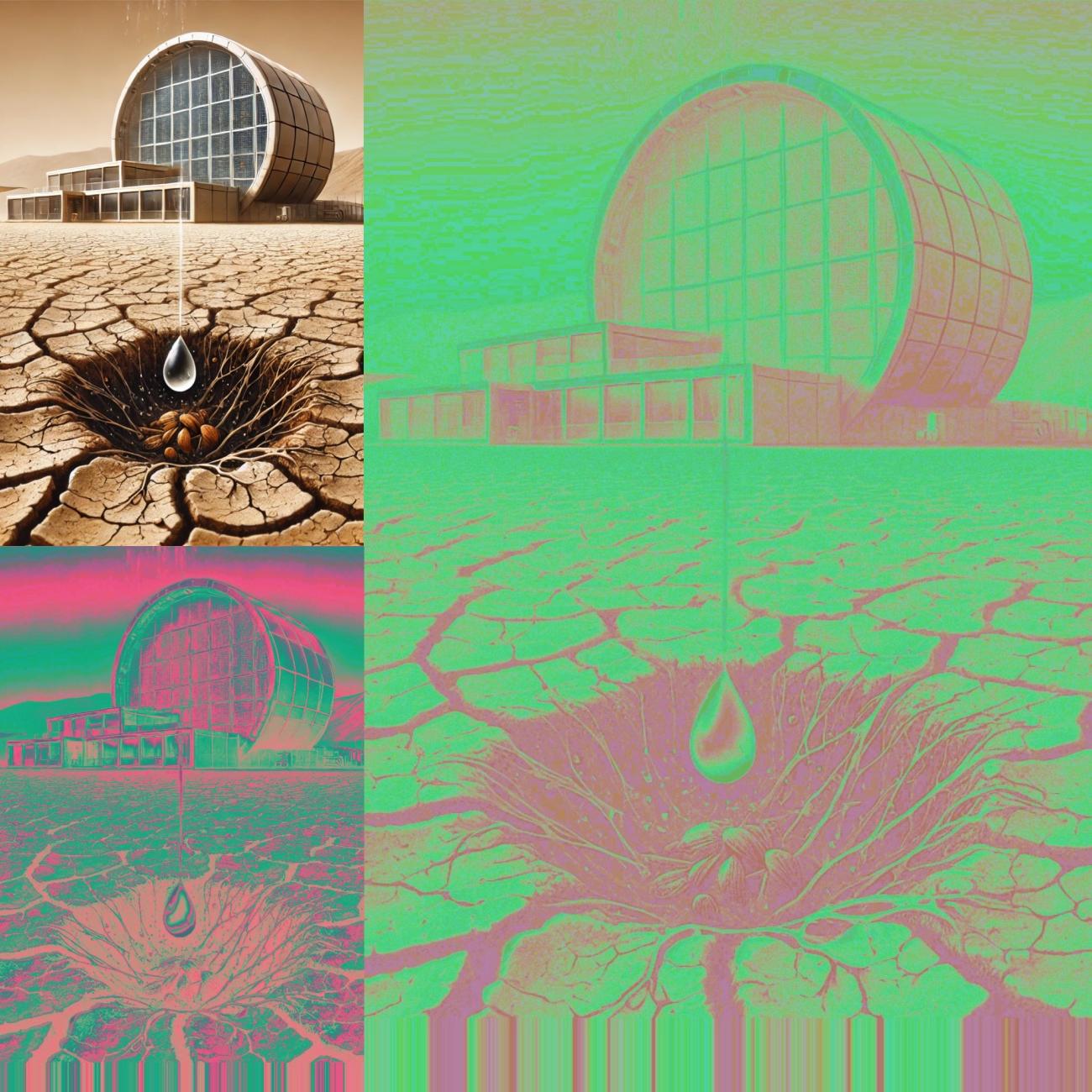
The Drop Beneath
"It's not supposed to rain for another week," Rayna muttered, staring at the cracked ground.
Her fingers clenched the thick report in her hand, a forecast warning of yet another dry spell. She didn’t need the report to know it was bad—every inch of the land beneath her sneakers had the feel of death. Austin’s water reservoirs had dwindled to a shadow of their former selves, rationing was becoming tighter, and every whisper of rain had turned into a myth passed between weary neighbors.
But Rayna Solis wasn’t the type to accept defeat. Two years ago, after her nanofabric breakthrough, she’d begun revolutionizing the way Austin thought about water. Inspired by the Namib beetles that survived in the most arid deserts by capturing water droplets from thin air, she designed a material capable of doing the same. Whole neighborhoods had lined up to get their homes clad in it—modular walls made from the synthetic weave that could trap moisture and slowly funnel it into small, personal reservoirs.
Austin had been declared a model of sustainability. Rayna was a hero.
But now, things were changing.
Rayna bent down, scooping a handful of dirt, letting the dry, lifeless particles sift through her fingers. "They said we could hold out," she whispered to herself, but the looming thought pressed against her chest. It had been six months since the fabric panels stopped capturing enough water.
Behind her, a footstep scraped the ground. Rayna straightened and turned to see Wes, her project lead, approaching. His face was pale, skin drawn tight over his cheekbones.
“Rayna, you need to come with me,” he said, his voice low, barely containing something like panic.
She raised an eyebrow. Wes was rarely ever rattled. Not since the early days when the prototype failed in the lab, and they had all been too stubborn to sleep. But now? Wes wasn’t the type to buckle. “What’s going on?”
“There’s something wrong with the panels.” He glanced around as though the cracked soil had ears, his voice dropping even lower. “We tested the newest batch this morning. And...well, it’s not just that they aren’t capturing water.”
Rayna’s heart kicked against her ribs. “What do you mean?”
“They’re expelling it. Everything they’ve harvested, all the moisture we thought we’d gained...it’s leaking out. It’s like...the fabric is rejecting the water.”
She blinked, disbelief spreading through her. “That’s not possible. We’ve tested this design for years.”
“I’m telling you, Rayna, something’s off. The fabric isn’t acting the way it’s supposed to anymore.” Wes ran a hand through his sweat-damp hair, the afternoon sun already baking them. “We checked the panels in three different districts. Same issue. Water levels are dropping.”
She looked down at her hands, at the skin caked with fine dirt, and rubbed her fingers together. “It can’t be…” Her mind raced, sifting through all the possible causes—temperature shifts, chemical imbalances in the air, faults in the material. None of it added up.
Wes shifted on his feet. “That’s not all.”
Rayna’s stomach dropped. “What else?”
“There’s something about the expelled water. It’s...changing.”
“Changing?” She folded her arms, waiting for the punchline. “Wes, what the hell does that mean?”
“We analyzed it,” he said, swallowing hard. “The composition of the water. It's not normal H2O anymore. There's...something growing in it.”
She stared at him, pulse hammering. Growing. She remembered the warnings she'd ignored—about the accelerated nature of the materials they’d engineered, about the possibility of unforeseen mutations. Rayna had dismissed them all. Water was water. What could possibly go wrong?
But now the water, their lifeline, their hope, was turning against them. Her mind scrambled, searching for a solution, but every thought was interrupted by a deeper, creeping realization that something far worse was happening. Something they hadn’t accounted for.
Rayna met Wes’s eyes. “How bad is it?”
He hesitated, glancing over his shoulder toward the distant outline of the city. “We found signs of it in the tap water. And in some of the reservoirs.”
Her breath caught in her throat.
“What do you mean, signs?” she asked, her voice nearly a whisper.
“It’s spreading, Rayna. And it’s moving faster than we can stop it.”
Rayna turned away, her eyes scanning the horizon, but instead of Austin’s skyline shimmering in the late sun, all she saw were the dry cracks in the earth, stretching out like veins of a body that had already begun to wither. And now, something inside that body was growing.
Something she might not be able to control.
“Show me the water,” she whispered.
Wes nodded, and they began walking toward the lab.
But behind them, in the shadow of Rayna’s own house, a single drop of liquid shimmered at the corner of the wall, sliding free from the panel and falling into the dust below.
The dirt hissed, the ground rippling as if disturbed by the drop. Something dark curled beneath the surface, twitching once before disappearing.
Rayna had no idea that the earth itself was beginning to wake.
🚮 W.A.S.T.E.: Words Assisting Sustainable Transformation & Ecology
| Term | Definition |
|---|---|
| Ambrosia trifida | Ambrosia trifidaGiant ragweed. By late summer it is taller than you, and the whole city sneezes in its direction. The Botanical Gardens keep a patch by the gate, with a label. |
| Arrival Hour | Arrival HourThe hour a crowd gathers to be seen rather than to see. A stranger took apart a shopping cart behind the bus station, and they stayed until dark without being able to say what they were waiting for. |
| Biomimicry | BiomimicryAsking the termite mound how to cool a building, and the leaf how to hold water, and writing down the answers. Credit goes to the termites. |
| Circular Economy | Circular EconomyNothing leaves; it changes hands. In 2045 money has turned into rings, like a tree has, one for each year of rain. You offer a story and a ring goes out. You need a wrench and a ring comes back. |
| Clandestine Collective | Clandestine CollectiveWhoever planted the wall at dawn. They work in the hours nobody is watching and sign nothing, and a garden shows up on a Tuesday and everyone says it was always there. |
| Code Rain | Code RainThe digital mist that falls when the network synchronizes. It leaves nothing on your sleeve, and your shoulders come down anyway. |
| Creekside Testament | Creekside TestamentA postcard tucked into a paperback about trains and distance, in a Little Free Library on the way to Clarksville. On the back, in faint writing: The creek remembers. |
| Elle West | Elle WestA rebranded laundromat pretending to be a bar: kombucha on tap, pipes painted black, light too cold for comfort. Mid-cycle in Unit 14 the spin thins to a hum, a seam opens, and there is a hatch. |
| Fridge Oracle | Fridge OracleThe refrigerator hums in the key of whatever you were arguing about. Jules and Alex were asking whether love is attention or appetite, and it got louder. |
| Glitchtotem | GlitchtotemA banner printed wrong and hung anyway. By Friday somebody has left a candle under it, and the broken instructions are read aloud on the corner like scripture. |
| Legacy Fault | Legacy FaultA crack poured into the foundation on purpose, to open when history needs it to. In Underneath the Neon the asphalt splits into a spiderweb of light. |
| Mimicry Commons | Mimicry CommonsA shared lot where copying is how things spread and credit is how it is paid. Nobody guards the gate. Everybody leaves a note about what they took. |
| Rootroom | RootroomThe chamber you imagine under your feet. No floor, walls of breath and time, deeper than any court or agency or failed system. Root there before you answer the letter. |
| Shoal Creek | Shoal CreekAt the Seaholm Intake the creek runs both ways for a breath, a light on the rail comes on when the current flips, and people leave rested and clear, as if a long afternoon had just ended. Come without hurry. A tin plaque on a boulder downstream says LISTEN HERE, and the metal under it is polished by hands. |
| Tradescantia pallida | Tradescantia pallidaPurple heart. Leaves the color of a bruise that is healing, small pink flowers, and roots wherever a stem touches. Frost takes it to the ground and it comes back from the root. Edward Palmer collected the first one near Ciudad Victoria in 1907. |
| Waste Integration | Waste IntegrationNothing is sent away. Crushed glass goes to the trellis shop on Aldrich, bike tubes to the woman who makes them into hinges, cardboard to the cube makers. The van goes that way anyway. |
| Watersheds | WatershedsThe door carved with rivers and creeks. Behind it each creek tells its own story: Shoal, Waller, Walnut, Boggy, Fort Branch, and Settler’s Creek, which belongs to Marigold Town. |