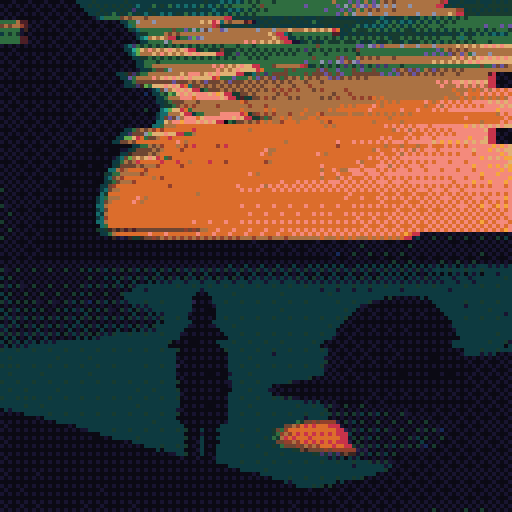
The Measure of Hollow Things
Every night, just before the heat folds back into the limestone and the drones blink out above the highway, the bats rise from the cave off 290. A ribbon of them, thin at first, like a secret testing the edges of a whisper. Then more. A rush. A violent cloud.
That summer, no one had seen Vera Quan.
She wasn’t exactly famous, but you wouldn’t call her obscure either. Artist, essayist, known for her field recordings and lecture-performances, the kind of person who didn’t so much speak as vibrate meaning into a room. Her last talk was held underground, in a reclaimed recharge zone below the Edwards Aquifer, where the city once tried to reroute water like it rerouted people — quietly, bureaucratically, and without apology.
I didn’t know her well. We’d only met twice. Once at a city-funded art show in the Seaholm Intake Building, where she spoke about “form as control,” and once again at a backyard party where someone was grilling jackfruit. Both times she had that look — like she was already listening to something you couldn’t hear yet.
The disappearance was not sudden, but it was complete. No calls. No posts. No scheduled appearance at the Salado symposium. The first people to notice were the archivists, the second were the poets. Her absence unfolded not with urgency, but with a kind of sinking.
⸻
The story goes that Vera’s final lecture was about emptiness. That she performed it without a script, pacing slowly across a cracked concrete floor beneath the city, her voice echoing against limestone walls wet with old water. “This,” she began, “is a lecture written with my voice.” And then: “The cave is not known by its walls, but by what spills out of it.”
They say she described the bats in great detail — how they emerge from the hole like punctuation marks, how their volume gives shape to the space they leave behind. A kind of negative geometry. The measure of hollow things.
That detail stuck with me. The idea that you can only know a place by what exits it.
⸻
I began walking more after she vanished. Not out of intention, but because my body seemed to want something that didn’t involve a screen or another message marked “urgent.” I wandered Shoal Creek, poked around the edge of the closed-off section near 183, passed the signs about water quality and rattlesnakes.
And one day, I found her name again — not in a news alert or on a flyer, but etched into a limestone block behind the old Whole Earth store: V. Quan — 2029. It was faint, half-covered in moss, but I knew it wasn’t a mistake.
I started looking for other signs.
⸻
The city’s map of the aquifer is elegant and clean — a blue rectangle stretching beneath everything from the edge of the desert to downtown. But that’s a fiction. Anyone who’s dropped a sensor into the groundwater knows better. The rock is spongy, carved with impossible time. The water moves like memory — slow, partial, untraceable. Vera once called it “a negative ecology.” She said the aquifer was an archive that refused to be cataloged.
What if she’d gone into it? Not metaphorically, but physically?
⸻
I met an old contact, Julia, a hydrologist-turned-sculptor who now lives in a suspended greenhouse off Montopolis. She keeps air plants, solar stills, and broken ceramic chairs wired to recording devices. Julia said Vera had been experimenting with “acoustic sediment.” Using field recordings of dripping water to write text — not language exactly, but vibration, echo, interval.
“She told me the cave was her final collaborator,” Julia said. “That it was teaching her to un-write.”
I didn’t ask what that meant.
⸻
Three months later, a film appeared online. No metadata, no credits. Just a static shot of the bats rising at sunset. Thirty uninterrupted minutes. Then silence. Then, at minute thirty-one, Vera’s voice — distant and calm:
“I watched the bats leave and understood the cave not as emptiness, but as the record of everything it had held. What pours out is a way of knowing. And what remains is not absence, but volume.”
The screen went dark.
⸻
I don’t know if she’s alive. But I do know that I began hearing water differently after that. Every faucet, every puddle, every echo in the tunnel under Mopac felt like a whisper. Not of her, exactly — but of something she touched. The city had always tried to forget what flowed beneath it. Vera reminded it.
Sometimes, at night, I walk to the mouth of the cave. I watch the bats emerge, a thin line, then a chaos, then a dance.
🚮 W.A.S.T.E.: Words Assisting Sustainable Transformation & Ecology
| Term | Definition |
|---|---|
| (Underground) | (Underground)The archive under the garden. There is a stone with a mark cut into it, a hatch behind the dryer in Unit 14, and a sub-basement door that is supposed to be locked. All three open on the same shelves. |
| Bat Weather | Bat WeatherThe hour before the Congress Avenue bridge lets go of its bats. The air goes still, people line the rail, and a million and a half wings decide on a direction at once. |
| Cane of Blossoms | Cane of BlossomsThe elder’s staff, carved with flowers as if the wood had grown them. When it strikes the boardwalk twice, the next thing she says is for the child you were. |
| Clandestine Collective | Clandestine CollectiveWhoever planted the wall at dawn. They work in the hours nobody is watching and sign nothing, and a garden shows up on a Tuesday and everyone says it was always there. |
| Cultural Shift | Cultural ShiftRings of contribution where the price tags used to hang. The library is the main street now, and the depot, and the garden, and the mycelium carries the news. |
| Eva Marquette | Eva MarquetteA ReLeaf scientist who turned rebel when she saw what the Gardener was doing to the ecosystems. In Tangled Frequencies she steps out of an oak’s bark on her own, changed, still herself enough. Her voice rattles Langley’s chest. |
| Future Austin | Future AustinAustin, a few decades on: the same creek, the same bridge at dusk, a few more vines than the zoning allows. Everything here happens to people who are trying, and are not always right. |
| Glyphseed | GlyphseedA mark that grows in soil or on a screen and comes up as a decision. The hummingbird that came out of the creek wore one on its back, shaped like a love letter on fire. |
| Immigration | ImmigrationDiego came to Austin with one bag and three languages and picked up two more in the line for water. In the Camp the children chalk a hopscotch grid where the trucks used to idle. |
| Photosynthetic Choir | Photosynthetic ChoirLeaves in the wind, all agreeing at once. The Treaty Oak is in the middle of it, and a woman keeps glancing up to check whether it was the tree who spoke. |
| Planterns | PlanternsA paper lantern turned into a planter, with an ID tied to a story, a song or a walk. No two are alike. Number 037, the first one, gives a single note, an E, and only when someone sings it. |
| Planthroposcript | PlanthroposcriptThe blueprint the vines write over your floor plan. Letters creep along the baseboards, a hallway thickens into a throat. It is not demolition. It is mood revision. |
| Rootpulse | RootpulseA faint vibration sensed through soil or concrete when bio-infrastructure awakens. |
| Sara Stevenson | Sara StevensonI’m a middle school librarian, and I first saw a free little library up in Seattle this summer. I’ve seen them popping up around town and told my husband I would love him to make me one. Never did I imagine he would produce such a fine piece of woodwork and construction, a mini replica of our house. Now I can be a 24-hour librarian. |
| Shoal Creek | Shoal CreekAt the Seaholm Intake the creek runs both ways for a breath, a light on the rail comes on when the current flips, and people leave rested and clear, as if a long afternoon had just ended. Come without hurry. A tin plaque on a boulder downstream says LISTEN HERE, and the metal under it is polished by hands. |
| Sunspine | SunspineThe ridges of the Strawbactus beds, warm at dusk because they spent the day collecting the sun. Put your palm on one after dark and it tells you how hot July was. |
| Trust Current | Trust CurrentA mild tingling behind the eyes when people witness a verified act of generosity. Neurologists call it a mirror-empathy response; poets call it the return of faith. It makes memory slippery. |