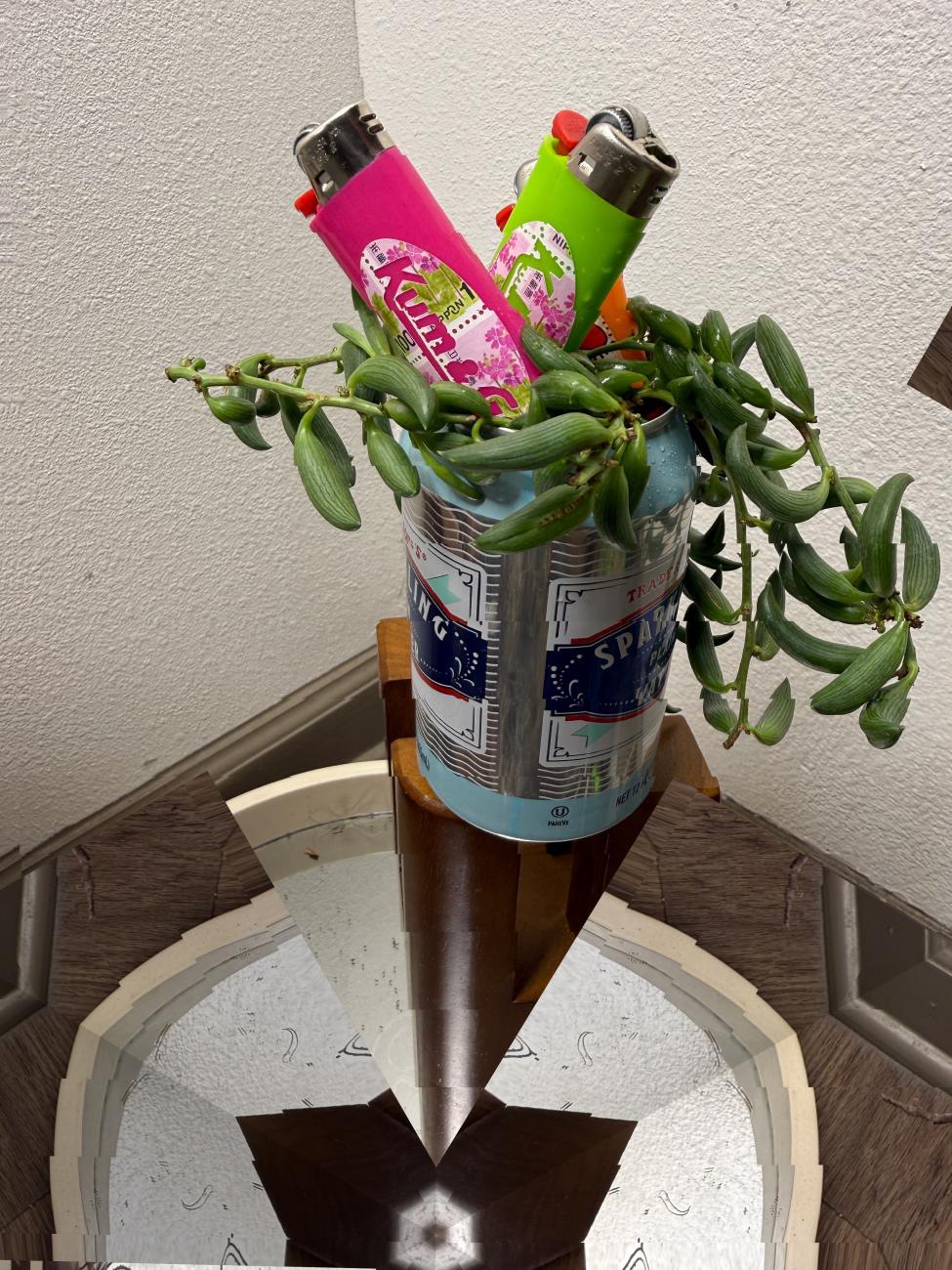
The can was never meant to hold a plant.
Once it carried sparkling water. Twelve ounces of small bubbles and aluminum chill. The top had been removed now, cut open in a careful ring. The bottom punctured so water could escape when it had done its work. The can still carried its printed label, slightly scuffed, as if remembering its earlier life but not insisting on it.
Inside, the contents had been arranged like a quiet stratigraphy.
First the gravel. Pebbles from Shoal Creek, gathered slowly from the shallow bends where limestone shows through the water. Smooth pieces of reef turned to stone, stone turned to creekbed.
Among them, several small fossils.
Gastropods, spiraled and pale. Remnants of a sea that once covered this place long before the creek, before the city, before the trees leaning over the banks. A hundred million years ago something soft-bodied had crawled inside those shells beneath warm water.
Now the shells rested inside a beverage can.
Above the gravel lay soil. Above the soil, the plant.
A succulent spilled over the rim in thick green arcs, each leaf curved and ribbed like a small sculpted finger. The plant had accepted its container without protest. Plants rarely object to improbable arrangements.
Three lighters stood among the leaves.
Two were easy to see. One pink, one bright green. Their plastic bodies carried the logo of a convenience store that had once dotted highways and small towns across the Midwest.
Kum & Go.
The letters curved cheerfully across the plastic. The ampersand leaned between them with casual enthusiasm. The name had always managed to hover somewhere between innocent branding and a joke everyone understood but rarely acknowledged aloud.
The stickers had been decorated.
Japanese postage stamps had been applied over parts of the logo, small blossoms and delicate colors interrupting the bold lettering. A quiet collision of geographies. Bureaucracy turned ornament.
The third lighter stood deeper in the foliage.
Its surface carried fragments of a U.S. Forever stamp. The design had been cut and rearranged carefully so that parts of the stamp wrapped around the plastic body.
The stamp showed two small figures in the unmistakable language of Keith Haring’s drawings. Black outlines on white. They held a bright red heart between them, arms lifted upward as if supporting it together.
But the stamp had not been left intact.
Certain edges were trimmed away where the Kum & Go lettering needed to remain visible. The red heart remained centered, though slightly shifted. The figures still held it above their heads, though now their posture had a faint sense of adjustment, like dancers finding balance after a turn.
The word Forever remained in small print along the edge.
Forever, printed on a stamp designed to travel once across an envelope and then disappear into the quiet archive of the postal system.
Forever, pressed against a disposable lighter.
The planter sat on a wooden pedestal.
The wood had once belonged to a bed. Not the visible frame, but a structural piece from within it. A leg insert from a set of Japanese joinery, cut with quiet precision so that wood could hold wood without metal or glue. The geometry of the joinery remained intact, the surface polished by time and handling.
It rose upward like a narrow column and ended in a square platform where the aluminum can now rested.
Below it sat a mirrored tray.
The reflection doubled everything. The plant appeared again beneath itself, softer and dimmer. The lighters became small colored pillars pointing downward into a second room that existed only in glass.
Sometimes water dripped from the punctured bottom of the can. It fell onto the mirror in a small bead and spread outward before disappearing again.
If someone leaned close enough, the fossils could be seen beneath the soil line.
A pale spiral. A quiet curve.
The room held that particular stillness that arrives before evening fully settles. Light from a nearby window rested across the leaves, turning their green surfaces luminous for a moment.
Outside, distant traffic moved through the city. Somewhere a door closed. Somewhere else someone laughed, the sound traveling briefly through the air before dissolving.
Inside the planter, time remained stacked in patient layers.
Ancient ocean shells. Creek gravel. A plant drawing water upward. Three small machines for making fire.
Postage stamps promising forever.
And a pair of simple figures, black outlines on white, lifting a red heart together without appearing especially concerned about where it had come from or where it might go next.
The fossils did not comment.
They had already witnessed the long arrival and departure of oceans. They had endured pressure, uplift, erosion, and the quiet labor of water wearing stone down into pebbles.
A houseplant and three lighters were modest developments.
Above them, the succulent leaned gently over the rim of the can, its thick leaves reaching into the room as if listening.
And in the mirror below, the entire arrangement continued again upside down, waiting patiently for whatever small fire or small moment might happen next.
⁂ A thread in the Thin Season.
The Commons · 4 of 4 · ← The Stack
🚮 W.A.S.T.E.: Words Assisting Sustainable Transformation & Ecology
| Term | Definition |
|---|---|
| Anti-Time Picnic | An impossible gathering where participants bring only borrowed artifacts, practicing memory as exchange rather than possession. |
| Bryce | A wandering steward of stories and seedlings, moving between libraries and creeks with pockets full of cuttings and unfinished sentences, leaving behind fragments that root themselves into community. |
| Shoal Creek | Shoal Creek is changing. At the Seaholm Intake, the water and stone hold a new role for the city. Engineers and naturalists are close to confirming a time-bending effect in the current. Short pulses move both downstream and upstream. Standing near the intake leaves people rested and clear, as if a long afternoon just ended. This site becomes a public time commons. The cooled chambers host sensors and quiet rooms. The walkway links to Central across the water. The mycelium network listens, then routes what the creek gives: steadier attention, better recall, and a calm pace for work and care. What to expect: Check-in stones that log a short visit and return a focus interval Benches that sync with the flow and guide five-minute rest cycles A simple light on the rail that signals when the current flips A small desk for field notes and shared observations Open data on pulse times so neighbors can plan repairs, study, and gatherings Invitation Come without hurry. Sit by the intake. Let the water set your pace. Then carry that steadiness back into the city. |
| Upcycling | Making a thing better than it was by making it into something else. In the city it stopped being a word anyone said aloud; it became the ordinary way of doing things. |