Friday, October 23, 2026
One photograph, twelve ways
The book reaches thirty-six chapters and stops dead-ending, the Playdate plates get the dithering the Playdate crowd uses, and a drawn-plate experiment fails on purpose.
Lighthouse · Waypoint · Mechanical Bestiary
Yesterday went to pictures that can only be black or white. The Playdate has no gray, so every photograph of a lighthouse in Lighthouse has to become dots. I first tried to have the plates drawn instead, from nothing, as code: a scratchboard Highland Light, then a small pen-and-ink generator of our own. Both looked bad to me, and I said so. The record is kept, the lesson is written down, and the generator stays in the repository as a thing we tried.
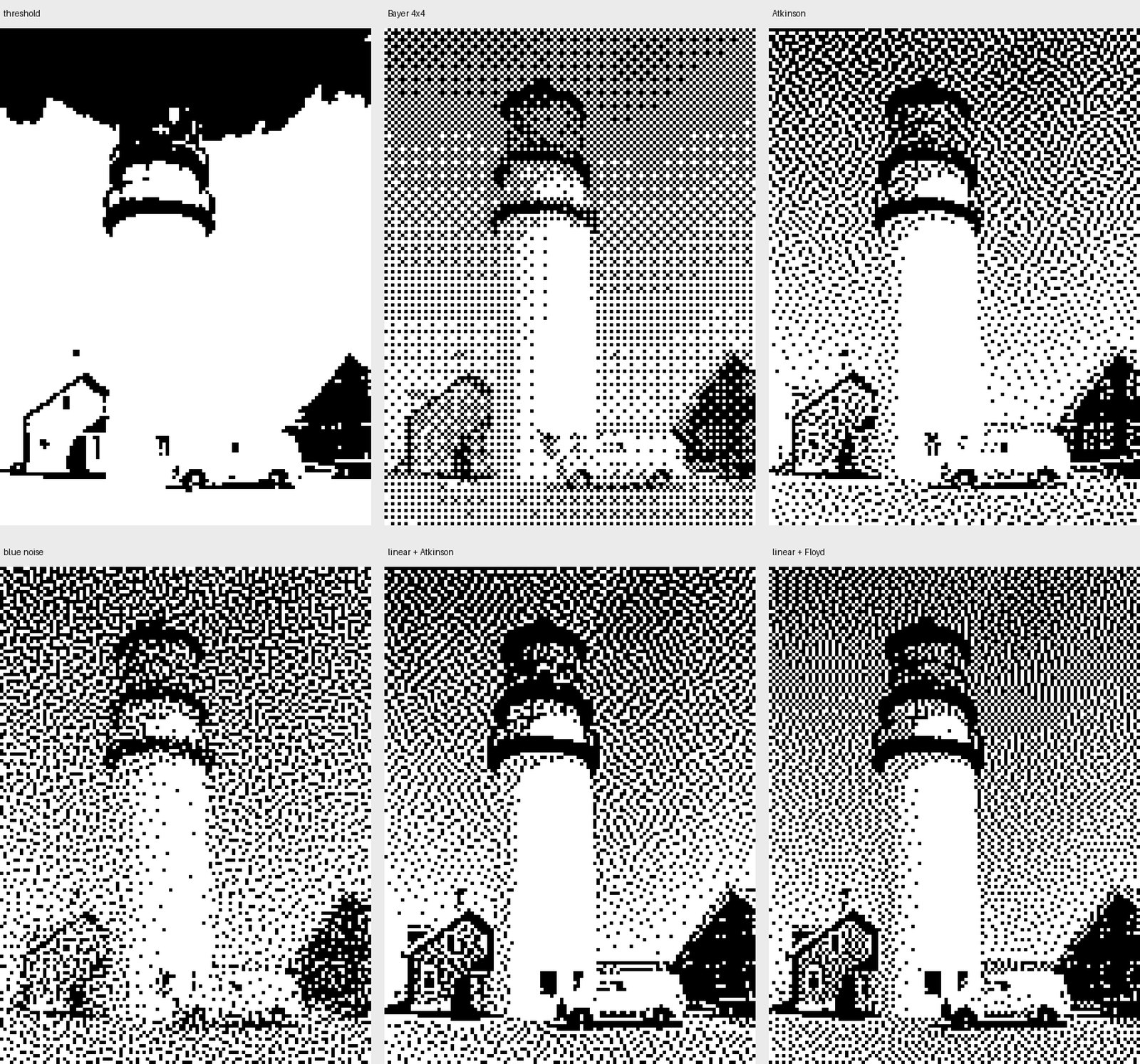
What worked was humbler: do what the Playdate community does. We ran three photographs through twelve conversions side by side, the ordered screens, the whole error-diffusion family, a blue-noise mask, and the step that matters more than any of them, fixing the contrast in linear light before a single pixel is decided. I chose Atkinson, the Macintosh look from 1984, because the whites come out clean and the edges hold. All thirty-three plates are regenerated, and three dark ones were lifted by hand.
The book grew. The Leaf With One Side went from nineteen chapters to thirty-six, each one read twice by people who had not seen each other's marks. Better than the count: no page is a dead end anymore. An unfinished branch bends to the nearest finished chapter and says so, every page opens three doors into the older stories on this site, and every one of those stories now opens back into the book.
Two decisions landed as well. The book keeps its title, and Waypoint on a folding phone will show the whole trail on one screen and the hiker on the other, which is built and waiting for my hands. And Apple accepted the studio into its Small Business Program, so when the first paid app goes on sale, 15 percent goes to the store instead of 30.
One honest thing. I spent hours sure that the small Linux machine that does our Android and Playdate work had crashed in the night. It had not. The building's Wi-Fi had quietly stopped letting my two computers see each other. They now talk over a private network of their own, and the first thing we check after any outage is the machine's own boot log, which would have said so in one line.
Sources and thanks
- The Highland Light photograph is by Cervin Robinson for the Historic American Buildings Survey, Library of Congress, public domain. The Truro Historical Society keeps the light.
- On dithering: Surma's Ditherpunk, Lucas Pope's notes on Return of the Obra Dinn, and Bill Atkinson's dither for the first Macintosh. The Playdate is made by Panic.
- The conversions, the reading tools and the first drafts had help from Artisanal Intelligence; every line here, and every chapter that went live, was read and chosen by a person.
Notes from the Workshop, once a month: releaf.site/beta/letter