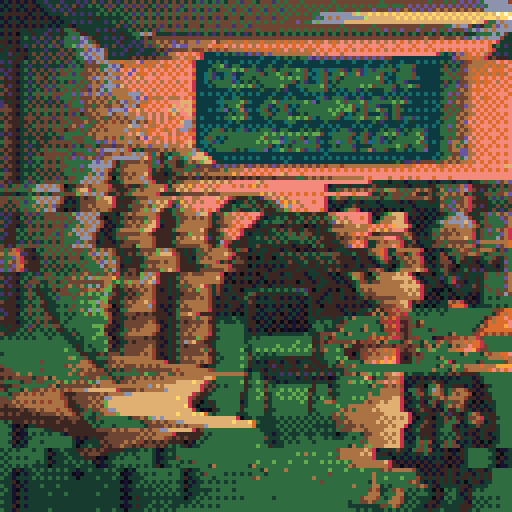
The Bureau of Myco-Civic Affairs was located in the basement of City Hall Annex B — a brutalist structure so hideous it had been declared a protected landmark of Anti-Beauty. The inside smelled like mildew, toner, and something faintly medicinal, like a dentist’s office that doubled as a mushroom farm. Which, as it turned out, it did.
I was there to apply for a permit to cultivate my small-batch, non-psychoactive, gourmet fungi. The kind that pairs well with grief and artisanal crackers. But you couldn’t just grow mushrooms in Austin anymore. Not since the Floravores began whispering in officials’ ears through the HVAC system.
A flickering sign above the reception desk read: WELCOME TO THE BUREAU / YOUR COMPLIANCE IS APPRECIATED. Beneath it, a woman named Rhonda with eyebrows like barbed wire handed me Form 11-C. “Fill this out. In triplicate. Using a pen approved by the Department of Occult Agriculture.”
“What if I don’t have one?” I asked. Rhonda slid a pen across the desk. It was covered in moss. It smelled like boiled regret. “Don’t sniff it,” she said.
⸻
Three forms and one mild nosebleed later, I was ushered into a room with blush-pink walls and fluorescent green carpeting. A single folding chair sat in the center, surrounded by microphones, mirrors, and what looked like a ceremonial compost heap.
A bureaucrat in a robe made of expired library cards entered. His name tag read GERRY and his mouth looked like it had never tasted joy. “Welcome, applicant. Are you aware of the spores you spread?”
“I—I just want to grow Lion’s Mane,” I said. “For cognitive support. And sandwiches.”
Gerry motioned to the compost heap. “The mycelium has concerns.”
From the heap, a low wet chuckle rose.
“Is this a zoning issue?” I asked.
A second robed figure appeared, this one in stilettos and a scarf made entirely of shredded tax documents. Her name was Maureen and her voice sounded like a kazoo full of secrets.
“You’ve skipped Form 13-H,” she purred. “The one where you disclose any unsanctioned communion with tree spirits, sentient lichens, or your ex-wife’s therapist.”
“None of those,” I said. “Well, except the tree. But only Qigong. Nothing erotic.”
Maureen raised an eyebrow that was very clearly tattooed on with a Sharpie. “We’ll need to inspect your root chakra.”
⸻
The inspection involved a clipboard, a blacklight, and a small puppet show performed by two interns dressed as fungi. One was enoki. The other was probably shiitake. The performance was called “Spore Me Once.”
When it ended, Gerry stood up and slowly clapped. “You’ve been deemed provisionally non-threatening. However, you will need to enroll in the Cultivator Re-education Seminar, complete a Community Integration Ritual, and offer up a symbolic object to the Spores of Record.”
“I have a wooden woodpecker I threw into the creek,” I offered.
Gerry’s face lit up. “A sacrifice of failed nostalgia. The Spores adore irony.”
Maureen smiled, revealing a gold tooth in the shape of the City of Austin logo.
“You may proceed,” she said. “But remember—fungi forget nothing. Especially violations of municipal code.”
⸻
I walked out into the daylight, clutching a permit soaked in brine and mystery. Across the street, a squirrel wearing a tiny reflective vest stared at me like it knew what I’d done. Somewhere beneath my feet, I could hear the spores laughing. Or maybe crying. Or maybe both.
And in my head, a phrase repeated in the voice of Rhonda: “Compliance is compost. Compost is love.”
The Council of Folders
There is a conference room beneath the Central Library that doesn’t appear on any blueprints. You can’t book it. You can’t enter it unless you’ve made a sufficient number of binders. The binders are key. Leather, vinyl, repurposed vinyl records, thick with laminated pages and pointless charts. If you’ve made at least seven binders of “Operations Overview,” your name begins to shimmer faintly in the marble lobby’s floor, just out of range of the security cameras. A flicker. A glitch in the terrazzo.
On this particular Wednesday, I was ushered down by an intern named Sharla, who wore a bolo tie shaped like a snail and spoke entirely in grant-speak. “Your deliverables have ripened,” she whispered, guiding me past a door disguised as a staff microwave. “Your metrics are flowering.”
We descended a ladder made of defunct library cards, sticky with the sweat of obsolete knowledge. Below, the Council of Folders was already in session.
They sat at a table shaped like a pentagon with one corner bitten off. Each wore a robe made of shredded TPS reports. The Chair—an elderly woman who introduced herself only as Nora from Payroll—had a printer toner cartridge for a necklace and a stare like sun-scorched bubble wrap.
“Proceed,” she croaked. “Report on the Status of the Petition.”
I opened my mouth. Nothing came out but a puff of confetti—tiny bits of redacted text. They nodded solemnly.
“The Ritual of Copying must be completed,” said the man to my left, his teeth sharp from chewing through bureaucracy for decades. “Double-sided. Duplex or be damned.”
On the wall behind them hung a massive tapestry, not woven, but stapled—made from disused org charts and outdated onboarding manuals. In the center was the sigil I had seen before, encoded in my dreams, etched into the creek’s algae-slick concrete: two stylized woodpeckers pecking at a floating “56,” encircled by the words Fun Valley Never Ends.
I reached into my coat and placed the divorce paperwork on the table. It hissed faintly, like a mushroom releasing spores.
“You’ve done well,” Nora from Payroll said. “You may now choose your exit strategy: Escalation or Lateral Transfer.”
Before I could answer, the lights dimmed, replaced by a soft glowing mauve. A vending machine in the corner whirred to life, ejecting a single hummingbird carving with a price tag marked in tears.
It was the same one—my grandfather’s. But now scrawled across its wings in Sharpie was a warning: “NO UNSANCTIONED SYMBIOSIS.”
I chose Lateral Transfer. They applauded with rubber stamps.
Upstairs, the jackhammers began again, pounding the pavement in a staccato rhythm that almost sounded like applause—or maybe laughter.
🚮 W.A.S.T.E.: Words Assisting Sustainable Transformation & Ecology
| Term | Definition |
|---|---|
| Ancestral Signal | A pulse older than electricity. A film of bacteria from Walnut Creek, between two copper plates, rose once for eleven minutes at the exact time the antenna at Central went on the air. Ana wrote under the readings: It is listening for something. |
| Cane of Blossoms | The elder’s staff, carved with flowers as if the wood had grown them. When it strikes the boardwalk twice, the next thing she says is for the child you were. |
| Choose Your Own Adventure | A book you read with one finger saving the last choice, so that if a page ends badly you can go back. It always ends badly once. |
| Compost | What the roof does with last week. It is warm in the middle in any weather, and in the stories everything ends up there eventually, including compliance. |
| Cultural Shift | Rings of contribution where the price tags used to hang. The library is the main street now, and the depot, and the garden, and the mycelium carries the news. |
| Harry Ransom Center | The University of Texas archive that keeps Denis Johnson’s papers: early drafts, letters, the small evidence of a writer’s life. You ask for a box. They bring you the box. |
| Ivory-billed Woodpecker | The last accepted sighting was in 1944. Over East Austin, if the reports hold, it is back, its call bouncing off the glass at dawn, on a green tower, with nothing to prove it but the sound. |
| Mycoremediation | Fungi hired to do what nobody else would: eat the cleaning fluid, drink the runoff, mend the creek bank from underneath. In the Stack the mycelium also remembers. A memory of heat prepared it for more heat. |
| Planterns | A paper lantern turned into a planter, with an ID tied to a story, a song or a walk. No two are alike. Number 037, the first one, gives a single note, an E, and only when someone sings it. |
| Shoal Creek | At the Seaholm Intake the creek runs both ways for a breath, a light on the rail comes on when the current flips, and people leave rested and clear, as if a long afternoon had just ended. Come without hurry. A tin plaque on a boulder downstream says LISTEN HERE, and the metal under it is polished by hands. |
| Surrealism | A diner with owls for waitstaff, and a waitress who asks if you want pie or closure. Is there a difference, you ask, tasting cherry and grief. |
| Treaty Oak | The live oak that was poisoned in 1989 and did not die. In one story it speaks for conservation, and a woman named Jenna keeps glancing up to check whether the leaves moved. |
| Vic Tandy | The engineer who found a ghost in a laboratory and traced it to a fan: a sound too low to hear that put a gray shape at the edge of his eye. Upstairs from the Council of Folders the jackhammers start again, and you feel them in your chest. |
| Waspathy | Soft courtesy with a sting folded inside it. Neighbors arrive with it in their smiles, polite as rattlesnakes at dusk, and the rent is gentle. |
| WasteSpeech | The city’s grammar. Every alley has its own syntax: bottles grown into trellises, chip bags pressed into shade. Its rhythm is measured in reuse, and it falters when a silver cube turns up with nothing to say. |