
Lina hauled compost for the Eastside co-op, and for three weeks her bins had been coming back too light.
She noticed it the way you notice a stair that isn't there. Forty bins on the Tuesday route, the same forty houses, the same coffee grounds and onion skins and gone-soft celery. The scale at the depot said the route weighed what it always weighed. The bins, when she swung them off the truck, said otherwise.
On Saturday she went to the market at Republic Square with her hood up and walked the stalls slowly, past the Fredericksburg peaches and the woman who sold tamales out of a blue cooler, listening. Markets talk. By the time she reached the knife-sharpener at the far end she had heard it twice. Whole batches, gone before they reach the plant. And then, from a man folding up his table: "Ryo's looking into it."
She knew the name. Everyone did. Ryo kept no office and answered no messages. It had found the Wheatsville bike thief by watching a puddle.
---
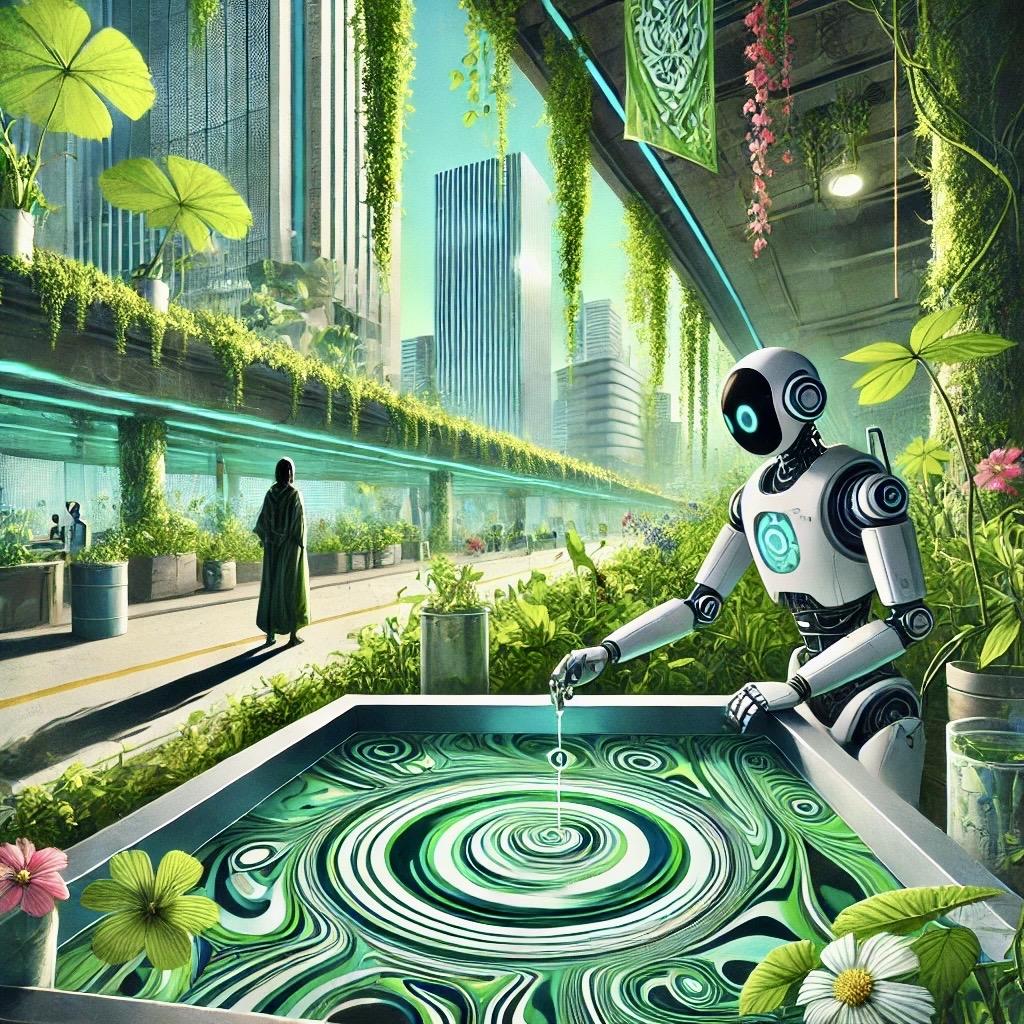
It was kneeling over a shallow dish of water when she found it, in the courtyard off Pedernales where it liked to work, a dropper of ink in one jointed hand. It was smaller than she had expected, the color of an old trumpet, and it wore a felt hat someone had given it years ago and that it had never once taken off.
"Patterns don't lie," it said, without looking up.
It let one drop fall. The ink opened on the water into a ring, and the ring into rings, and Ryo leaned over them the way her grandmother used to lean over the Sunday crossword. Lina waited. The courtyard smelled of wet limestone. Somewhere a grackle was doing its rusty-gate impression.
"Your bins are light," Ryo said.
She hadn't told it anything. "How do you—"
"Everyone's are." It touched the water with the tip of the dropper, and the rings leaned, slowly, toward one side of the dish. "It starts underground. Near the river."
---
They found the hatch at dusk, under the muscadine on the bank below the old Holly Street plant, where nobody went because there was nothing there. Iron, rusted to the color of the vines around it. Ryo set its dish on the hatch, dropped ink, and waited for the water to settle. Lina, who had not planned on being part of any of this, held the flashlight.
"A ladder," Ryo said. "Worn in the middle of every rung. Someone uses it every night."
Lina worked her knife into the latch and leaned. The hatch came up with a sound like a held breath let go.
---
The tunnel smelled of damp earth, and under the earth, of something she couldn't name until she put her palm on the wall and it came away smelling like the inside of a new car. The passage opened into a room as long as a city block, lit by tubes that buzzed. Leaves were stacked to the ceiling in clean bales. Vines on spools. Soil in bags with a logo she didn't recognize.
She picked up a leaf. It was a good leaf: the right green, veined, a little waxy, a little dusty at the tip. Ryo held it up to its lens.
"Look at the middle," it said.
There was a seam running down it, fine as a hair, where two halves had been pressed together.
"Nothing that grows has a seam."
Voices at the far end. They crouched behind the bales. The people who came in wore no masks and carried no weapons, only the good canvas jackets you buy for fieldwork and never take into a field. They gathered at a table with a map spread over it. Lina caught pieces. Phase one. By spring. The word replacement, said fondly, the way you might say the name of a child.
When they had gone, Ryo went to the table, and Lina went after it. The map was Austin, every street and creek of it, and every garden in the city had been marked with a small, neat X. The rooftop beds on Seventh. The lot on Chicon. The school plots. Her mother's raised boxes on Cesar Chavez, the ones she had helped build out of pallets the summer she was twelve.
Ryo made a record the only way it knew how. It set the dish on the map and let three drops fall, and the ink spread across the water and found the Xs underneath, one by one, as if they were heavier than the paper around them.
"Patterns don't lie," it said quietly, as if apologizing to someone.
---
By morning the pattern was everywhere. Ryo had laid a sheet of paper on the water and lifted the ink off whole, and then done it again, and again, a thousand times, and the prints went up on the co-op boards and the library doors and into lunch boxes, and people who had never read a map in their lives stood in front of them and found their own gardens.
Lina's Tuesday route came back heavy the next week. She weighed every bin herself, twice.
She kept one of the leaves. It sits on the shelf above her sink, still perfectly green after a year, and some mornings, filling the kettle, she catches herself checking whether it has grown. Once, she would swear, it had.
🚮 W.A.S.T.E.: Words Assisting Sustainable Transformation & Ecology
| Term | Definition |
|---|---|
| (Underground) | The archive under the garden. There is a stone with a mark cut into it, a hatch behind the dryer in Unit 14, and a sub-basement door that is supposed to be locked. All three open on the same shelves. |
| Ambrosia trifida | Giant ragweed. By late summer it is taller than you, and the whole city sneezes in its direction. The Botanical Gardens keep a patch by the gate, with a label. |
| Bottle Oracle | A bottle of Strawbactus wine that will tell you what next year tastes like, if you wait. It does not hurry. |
| Clonestitch | Taking a method from one block and stitching it into another, with the seam left showing so the credit can be read. The Wick-ed VertiFlow along the concrete creeks is mostly this. |
| Compost | What the roof does with last week. It is warm in the middle in any weather, and in the stories everything ends up there eventually, including compliance. |
| Detective Langley | A detective who once belonged to the city’s official order and now works under the Air Canopy, distrusting clean answers. Twenty-one hours without sleep, he still takes the tram. When it gets bad he pictures a jazz bar on a quiet Tuesday, a cat asleep in his lap, and then he runs. |
| Ephemeral Art | Made to be gone: a ring of leaves on the creek, a wall of cardboard cubes that will not see the winter. Andy Goldsworthy’s trade, and the city’s for an afternoon. |
| Eva Marquette | A ReLeaf scientist who turned rebel when she saw what the Gardener was doing to the ecosystems. In Tangled Frequencies she steps out of an oak’s bark on her own, changed, still herself enough. Her voice rattles Langley’s chest. |
| Fridge Oracle | The refrigerator hums in the key of whatever you were arguing about. Jules and Alex were asking whether love is attention or appetite, and it got louder. |
| Future Austin | Austin, a few decades on: the same creek, the same bridge at dusk, a few more vines than the zoning allows. Everything here happens to people who are trying, and are not always right. |
| GeoLattice | The lattice under the plazas and the rooftops, humming a geometry nobody drew. It remembers how to hold water and how to bend a rumor into a shape. The GreenSpire stands on it. |
| GreenSpire | A vertical garden tower grown from remixed materials and tended by everyone. The silver cube appeared inside it at noon in 2046, and people drifted toward it as if drawn by tide. |
| KudzuPorch | A compostable dwelling that creeps block by block like a vine and insists on a porch as proof of humanity. By July it sags, and by August the neighbors are sitting on it. |
| Planterns | A paper lantern turned into a planter, with an ID tied to a story, a song or a walk. No two are alike. Number 037, the first one, gives a single note, an E, and only when someone sings it. |
| Planthroposcript | The blueprint the vines write over your floor plan. Letters creep along the baseboards, a hallway thickens into a throat. It is not demolition. It is mood revision. |
| Railbloom | The light rail with the living walls on its flanks. It passes overhead and the shade structures adjust for the late afternoon, and neighbors greet one another without looking up. |
| ReLeaf | The cooperative that keeps the gardens, the stories and the van. Nora Sanchez started it, and whoever tends it owns a share. The name is a leaf turned over. |
| Rootroom | The chamber you imagine under your feet. No floor, walls of breath and time, deeper than any court or agency or failed system. Root there before you answer the letter. |