Sunday, November 1, 2026
A cover that has to stand beside a real book
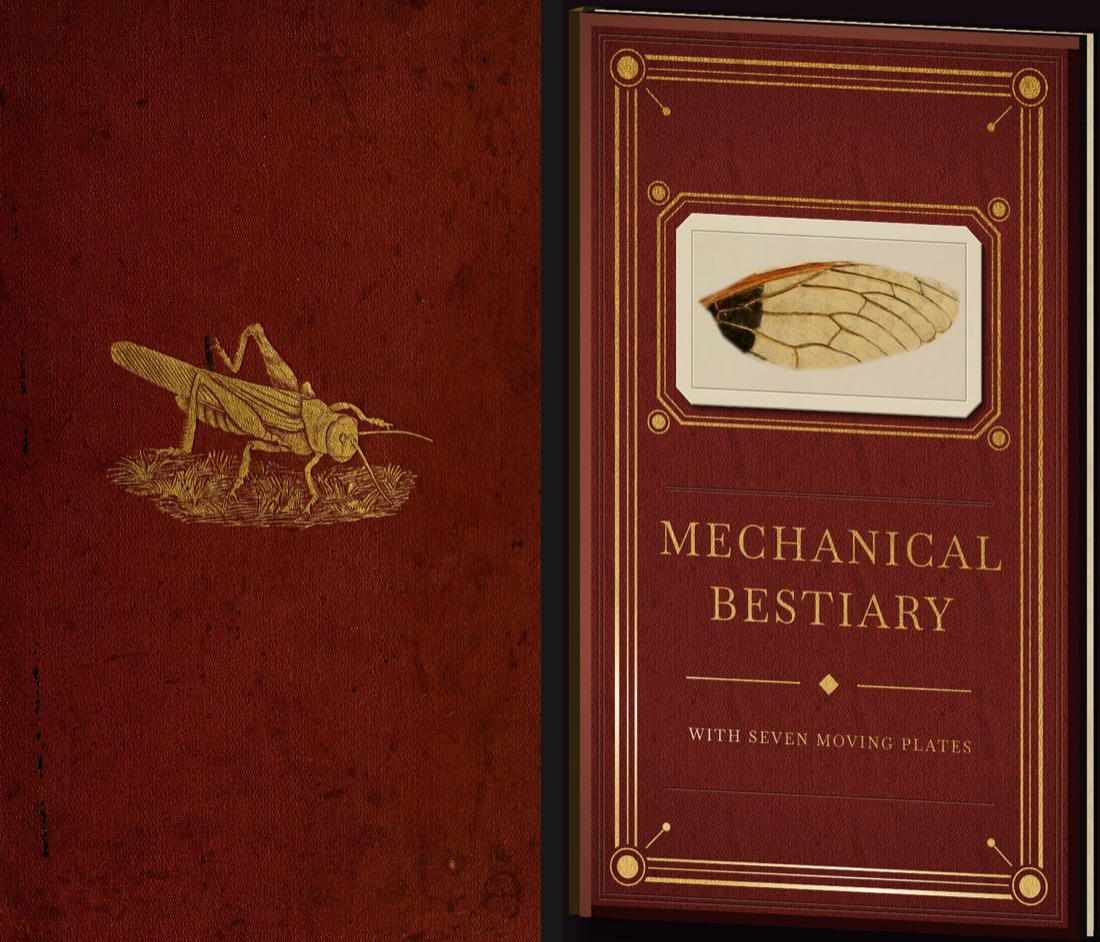
The Mechanical Bestiary's shut cover is redrawn against an 1872 publisher's binding, with cloth from a real scan and gilt that catches the hinge; Candy Crawl begins its winter coat as a gingerbread village.
Mechanical Bestiary · Candy Crawl
Yesterday the Bestiary's shut cover was called nearly finished, and then it was looked at beside a photograph of an actual book from 1872. It did not survive the comparison. A flat oval, a wing clipped inside it like a sticker, a thin rectangle for a frame, a typeface standing in for a design. Nothing on it had been made the way a cover is made.
So the rule changed before the drawing did. Every cover frame now goes into the evidence next to a photograph of a real binding at the same size, and the grade belongs to the pair, not to our frame alone. Then the redraw started from what the real ones have. The cloth is cut from the scan of that 1872 cover itself, an oxblood pebble grain, tiled and lit with a bevel at the board's edge. The gilt is one stamped design, rules and corners and the label's ring and the lettering together, and it glints: a highlight moves across the gold as the phone's hinge opens, because gold that does not move is tan paint. The cicada wing sits on a laid-on paper label with a cut edge, a hair of thickness and a plate mark, the way an engraving would be mounted. Under the title, in small capitals, the honest subtitle: with seven moving plates.
Candy Crawl missed Halloween, so it is becoming a winter game. Of three boards, a gingerbread village won, and the first slice is built: cookie walls with piped icing, a snow path, a gingerbread kid with a candle, and a skin that changes by the calendar on December 1. It is a B so far. The maze has to read as a maze before it gets to be cute.
One honest thing. Two of us had graded that cover A minus by looking at it on its own. A photograph of the real thing made the grade obvious in one glance. We cannot judge our own work in an empty room anymore.
Sources and thanks
- J. G. Wood, Insects at Home (Longmans, 1872), scanned by the Internet Archive, public domain; the cloth grain on our cover is cut from its scan.
- The title is set in Baskervville on Android (Open Font License) and in Baskerville on iPhone.
- The first drafts and the checks had help from Artisanal Intelligence; every line here was read and chosen by a person.
Notes from the Workshop, once a month: releaf.site/beta/letter